Employee Retention Strategies in Modern Workplaces 2026
 Hiring is only half the battle. The harder, more expensive half is keeping the people you've already hired. That's why employee retention strategies have moved from a back-office HR concern to a front-and-center business priority in 2026. With remote work platforms making it easier than ever for skilled professionals to be recruited away, organizations that don't actively invest in retention are quietly bleeding talent, knowledge, and money.
This guide breaks down what employee retention actually means, why it matters more than ever this year, how to measure it, and which employee retention strategies are working in real workplaces right now backed by practical examples rather than vague advice. What Is Employee Retention? Employee retention is an organization's ability to keep its employees over a given period of time, rather than losing them to resignation, layoffs, or competitor offers. It is typically tracked through a retention rate and is treated as a core indicator of workplace health, leadership quality, and overall employee experience.
In simple terms: if a company starts the year with 100 employees and ends it with 90 of those same people still on staff, it has retained 90% of its workforce. The other 10% left for any reason voluntary or involuntary.
What Is Retention Rate?
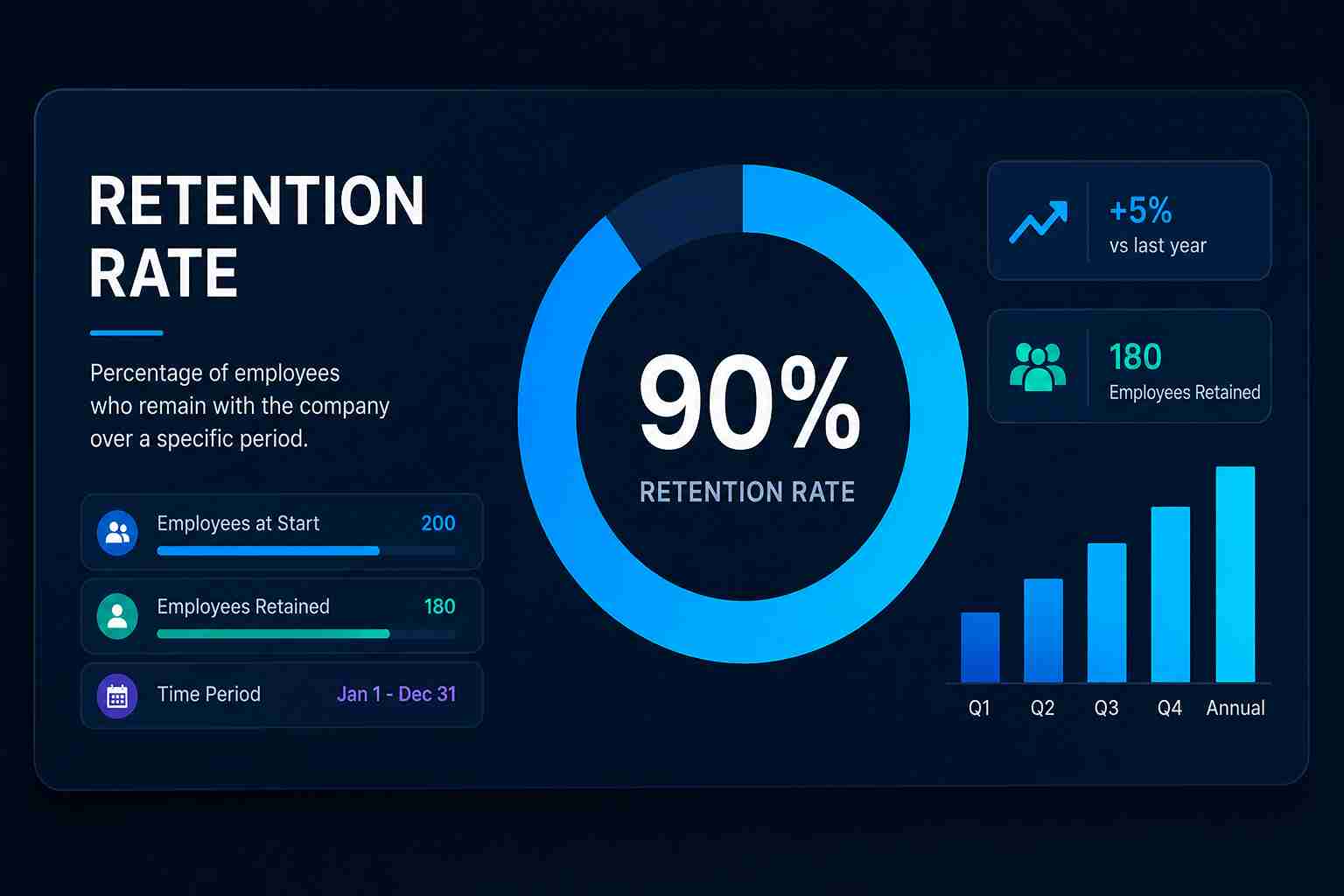 Retention rate is the percentage of employees who remain employed at a company over a specific period, usually measured monthly, quarterly, or annually. It's the single number most HR leaders use to track whether their human resource strategy is actually working.
How to Calculate Employee Retention Rate
If you're wondering how to calculate employee retention rate, the formula is straightforward:
Retention Rate = (Number of employees who stayed for the full period ÷ Number of employees at the start of the period) × 100
For example, if a company had 200 employees on January 1 and 180 of those original employees were still employed on December 31, the calculation looks like this:
(180 ÷ 200) × 100 = 90% retention rate
A healthy retention rate varies by industry, but most organizations aim for 85–90% annually. Anything noticeably lower is usually a signal that deeper issues culture, compensation, leadership, or growth opportunities need attention.
Why Employee Retention Matters More in 2026
The importance of employee retention has grown sharply because the job market itself has changed. Remote work and global hiring platforms mean a software engineer in one city can just as easily work for a company on the other side of the world. That mobility is great for employees and brutal for companies that haven't modernized their retention strategies.
High turnover doesn't just create an empty desk. It creates a chain reaction:
Increased hiring and onboarding costs for every replacement hire
Loss of institutional knowledge that took years to build
Reduced team performance while new hires get up to speed
Project delays and operational disruption during transitions
These employee turnover costs add up fast. Industry estimates commonly cite replacement costs ranging from half an employee's annual salary to nearly double it, depending on the role's seniority and specialization. That's precisely why reducing employee attrition is now treated as a measurable business KPI, not a soft HR goal.
Changing Employee Expectations
Salary used to be the deciding factor in whether someone stayed at a job. That's no longer true. Today's employees weigh the full picture of their work life, including:
Career growth opportunities
Flexible working arrangements
Work-life balance
A positive, respectful organizational culture
Ongoing learning and development support
When these expectations aren't met, even well-paid employees start quietly browsing job boards. This is why the most effective hr retention strategy frameworks now treat employee experience as a whole, not just a paycheck line item.
Best Employee Retention Strategies for 2026
Here are the best employee retention strategies organizations are using right now to keep their top performers engaged and committed.
1. Build a Strong Workplace Culture
 Culture is the foundation underneath every other retention effort. Employees stay longer in workplaces where they feel valued, respected, and included. Organizations with strong cultures typically focus on open communication, recognition of contributions, genuine collaboration, and trust-based relationships between teams and leadership.
Poor culture, on the other hand, is one of the fastest routes to higher turnover no benefits package can fully compensate for a toxic or dismissive environment.
2. Prioritize Career Growth Opportunities and Upskilling Employees
A lack of a visible career path is consistently one of the top reasons employees resign. In 2026, career growth opportunities aren't a perk they're an expectation. Companies retaining top talent are investing in:
Upskilling employees through structured training programs
Reskilling workforce members for emerging roles
Leadership development tracks for high-potential employees
Internal promotion pathways instead of always hiring externally
Access to on-demand learning platforms
When employees can see where they'll be in two or three years inside the company, they're far less likely to look elsewhere for that growth.
3. Offer Real Flexibility and Work-Life Balance
Remote work, hybrid models, and flexible hours have shifted from "nice to have" to baseline expectations. Companies that enforce rigid, inflexible schedules tend to see noticeably higher attrition, especially among employees with caregiving responsibilities or long commutes. Work-life balance is now a deciding factor in whether someone accepts a competing offer.
4. Invest in Leadership Development
Employees frequently leave managers, not companies. Effective leadership in 2026 looks like consistent communication, regular feedback, mentoring instead of micromanaging, and genuine emotional support during stressful periods. Leadership development programs that train managers in coaching-style supervision rather than pure authority-based management have a measurable impact on team-level retention.
5. Modernize Compensation and Wellbeing Initiatives
Salary still matters, but it's no longer the sole lever. Competitive organizations are layering in performance-based bonuses, mental health support, and broader employee wellbeing initiatives alongside flexible benefits programs. Employees increasingly evaluate the total value of their employment package, not just the number on their paycheck.
6. Use AI in HR Management for Predictive Insight
One of the most significant shifts in human resource strategy this decade is the move from reactive to proactive retention. AI in HR management now allows companies to monitor engagement trends, flag disengagement patterns, and apply predictive HR analytics to spot flight risk before an employee hands in a resignation letter. Paired with regular employee performance management reviews, this gives managers a real chance to intervene early through a conversation, a role adjustment, or a recognition gesture instead of reacting after the fact.
7. Make Employee Recognition and Rewards a Habit
 Employee recognition and rewards don't need to be expensive to be effective. Regular appreciation programs, peer recognition systems, and public acknowledgment of achievements consistently boost morale and loyalty. Employees who feel genuinely seen and appreciated are measurably more engaged and more likely to stay.
8. Build Internal Mobility Programs
Rather than losing skilled employees to outside companies, smart organizations create internal mobility programs that let people switch roles, move across departments, or take on new responsibilities without leaving the company. This keeps experienced employees engaged, reduces recruitment costs, and strengthens the internal talent pipeline for future leadership needs.
How to Improve Employee Retention: A Practical Framework
If you're asking how to improve employee retention at your own organization, start with these steps rather than trying to fix everything at once:
Calculate your current retention rate and benchmark it against your industry.
Run exit interviews and engagement surveys to identify the real reasons people are leaving.
Address the highest-impact gap first, usually culture, growth, or management quality.
Roll out one or two targeted programs (such as an upskilling track or a recognition system) rather than a dozen at once.
Use HR analytics to track whether engagement and workforce retention improve over the following two quarters.
Adjust and repeat retention is an ongoing process, not a one-time fix.
Employee Retention Strategies: Quick Comparison Table
Strategy | Primary Focus | Best For | Typical Impact Timeline |
Career growth opportunities | Long-term engagement | High-performers seeking advancement | 6–12 months |
Flexible work models | Work-life balance | Distributed and hybrid teams | 1–3 months |
Leadership development | Manager-employee trust | Teams with high manager-driven turnover | 6–12 months |
Employee recognition and rewards | Day-to-day morale | All employee segments | Immediate–3 months |
AI in HR management / predictive analytics | Early-warning detection | Large or fast-growing organizations | 3–9 months |
Internal mobility programs | Career variety without exit | Mid-to-senior employees | 6–18 months |
Turnover Costs vs. Retention Investment
Factor | Cost of Turnover | Cost of Retention Strategy |
Financial impact | 50%–200% of annual salary per replaced employee | Ongoing but predictable budget line |
Knowledge loss | High — institutional knowledge leaves with the employee | Minimal — knowledge stays in-house |
Team morale | Disrupted, especially after repeated exits | Strengthened through stability |
Productivity | Drops during hiring and onboarding gap | Maintained or improved |
FAQ Section
1. What is employee retention? Employee retention is an organization's ability to keep employees on staff over time rather than losing them to resignation or termination, typically measured using a retention rate.
2. What is retention rate? Retention rate is the percentage of employees who remain with a company over a defined period, calculated by dividing the number of employees retained by the number employed at the start of that period.
3. How Is Employee Retention Rate Calculated? Divide the number of employees who stayed for the entire period by the number of employees at the start of the period, then multiply by 100. For example, 180 retained out of 200 starting employees equals a 90% retention rate.
4. What are the best employee retention strategies for 2026? The best employee retention strategies for 2026 include offering clear career growth opportunities, flexible work models, strong leadership development, competitive compensation with wellbeing initiatives, consistent employee recognition, and AI-driven predictive HR analytics to catch disengagement early.
5. How can a company improve employee retention quickly? Quick wins typically include introducing or improving recognition programs, increasing schedule flexibility, and giving managers basic coaching training — all of which can show measurable engagement improvements within a few months.
6. Why is employee retention important for a business? Employee retention matters because losing employees is expensive, disrupts team performance, causes the loss of institutional knowledge, and slows down ongoing projects, all of which directly affect a company's bottom line and stability.
7. What role does AI play in HR retention strategy? AI in HR management supports retention by analyzing engagement data and workforce sentiment to flag early signs of disengagement, allowing HR teams and managers to intervene proactively rather than reacting after an employee has already decided to leave.
Conclusion
In 2026, employee retention is no longer just an HR responsibility. It has become a key business strategy that affects every department, budget, and leadership decision across the organization. The organizations winning the talent game aren't the ones offering the highest salaries; they're the ones building genuine career growth opportunities, flexible work environments, strong leadership, and a culture where people actually want to stay.
If you're rethinking your own human resource strategy, start small: calculate your current retention rate, identify your single biggest gap, and build one focused initiative around it before expanding further. Retention isn't about preventing people from leaving it's about creating a workplace they choose to stay in.
Recruitment in 2026: The Major Shift Toward a Human-Centric Talent Strategy
How AI Is Changing HR Processes in 2026