How AI Is Changing HR Processes in 2026: A Complete Guide
Introduction: The AI-Driven HR Revolution
The way organizations manage their people has been permanently transformed. In 2026, how AI is changing HR processes is no longer a theoretical discussion it is the everyday reality of HR teams across industries. From the moment a candidate submits a resume to the day an employee maps their five-year career plan, artificial intelligence now plays an active, measurable role.
Traditional HR operations were largely manual: screening hundreds of applications by hand, scheduling interviews over email chains, conducting annual reviews that barely captured a full year of work. These routine tasks consumed enormous time and left little room for the strategic, human-centered work that HR professionals genuinely excel at.
Today, AI in HR processes has changed that calculus completely. HR leaders now use data and technology to predict employee turnover, personalize training, automate payroll, and understand employee feedback in real time. The result? HR teams spend less time on administration and more time building the cultures, capabilities, and experiences that drive organizational performance.
This guide explores every dimension of how AI is changing HR processes in 2026 what's working, what still requires a human touch, and where the future of HR with AI is headed.
What Is an HR System and Why AI Matters
Before diving into transformation, it helps to define the landscape. What is an HR system? At its core, an HR system (also called a Human Resource Management System or HRMS) is the technological backbone that supports every stage of the employee lifecycle hiring, onboarding, payroll, performance tracking, and offboarding.
Standard HR procedures have historically been reactive: respond to vacancies, process paperwork, manage compliance. Modern AI-driven HR systems flip this model. They are proactive, predictive, and personalized.
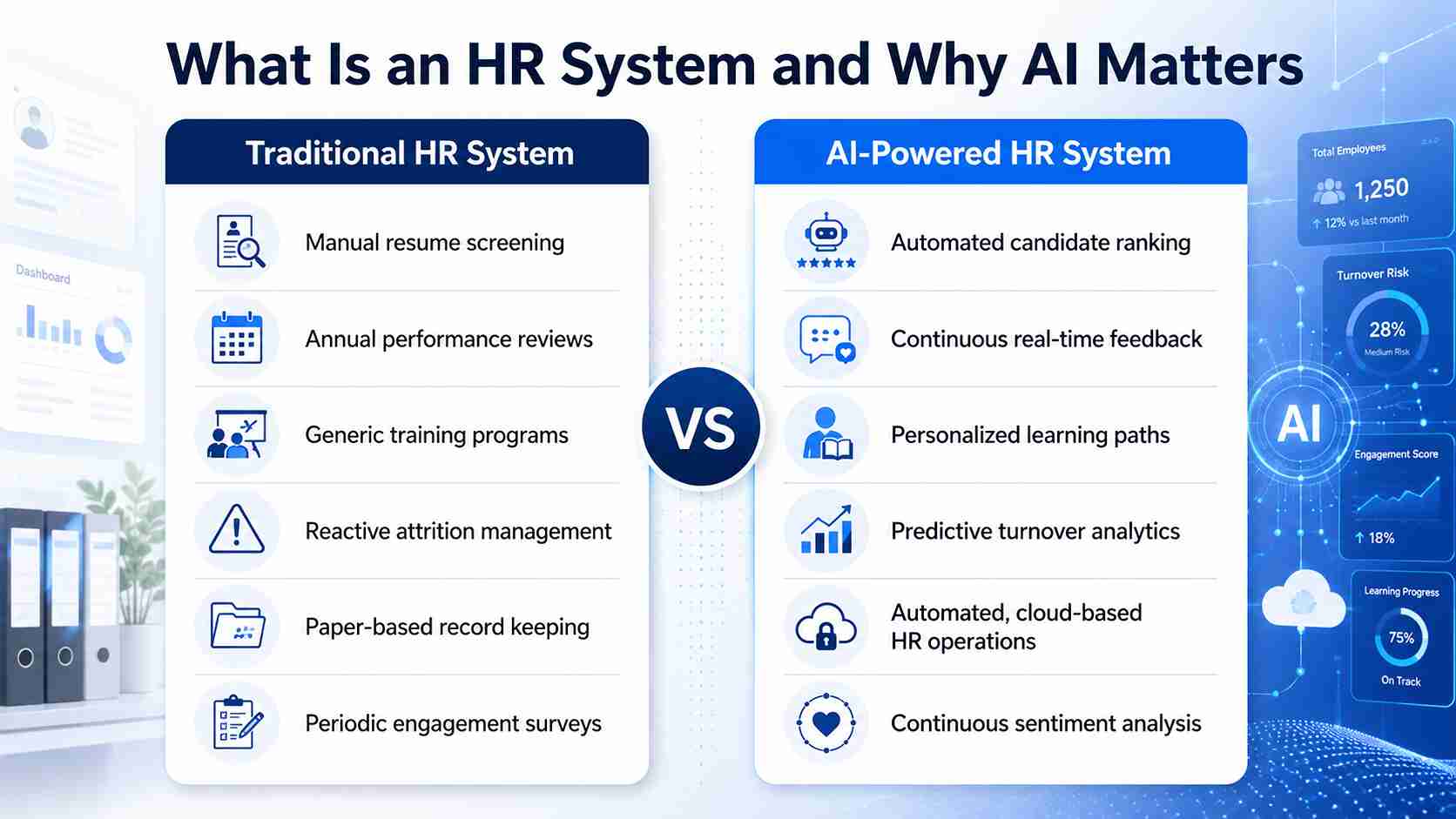
The key difference:
Traditional HR System | AI-Powered HR System |
Manual resume screening | Automated candidate ranking |
Annual performance reviews | Continuous real-time feedback |
Generic training programs | Personalized learning paths |
Reactive attrition management | Predictive turnover analytics |
Paper-based record keeping | Automated, cloud-based HR operations |
Periodic engagement surveys | Continuous sentiment analysis |
This table illustrates why organizations that have implemented AI in their HR core gain a structural competitive advantage in talent acquisition, retention, and development.
AI-Powered Recruitment: Faster, Fairer, Smarter
Recruitment is where the impact of AI on HR processes is most immediately visible. Filling a single role can generate hundreds sometimes thousands of applications. Without AI, screening that volume fairly and efficiently is nearly impossible.
How AI Is Transforming Talent Acquisition
Modern AI recruitment tools analyze resumes in seconds, matching candidate skills to job requirements with a precision no human reviewer can match at scale. More importantly, well-designed AI systems can reduce unconscious bias by evaluating candidates against objective, role-specific criteria rather than pattern-matching to previous hires.
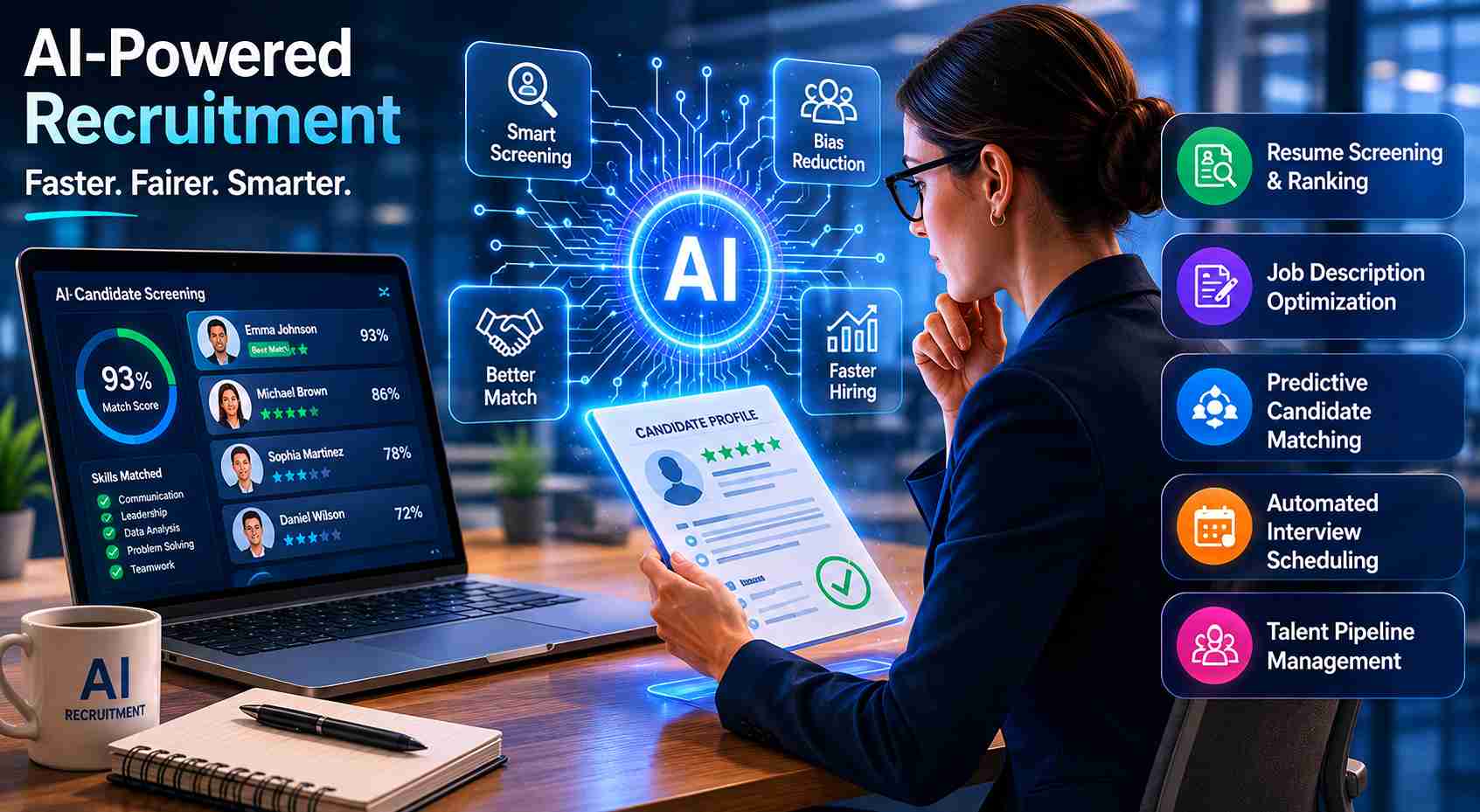
Key AI applications in talent acquisition include:
Resume screening and ranking: algorithms score applicants against defined criteria, surfacing the strongest candidates first
Job description optimization: AI flags biased or exclusionary language before a post goes live, widening the talent pool
Predictive candidate matching: systems compare applicant profiles against high-performing employees in similar roles
Automated interview scheduling: eliminating back-and-forth email chains with AI-powered calendar coordination
Talent pipeline management: AI tracks passive candidates and re-engages them when relevant roles open
The result: significantly reduced time-to-hire, lower cost-per-hire, and a candidate experience that feels responsive rather than transactional.
Expert Insight: The most effective organizations in 2026 use AI to handle the volume and data work of recruitment, while human recruiters focus on relationship-building, employer brand storytelling, and final-stage evaluation. Neither alone produces optimal outcomes.
AI in Onboarding: Personalized from Day One
The first 90 days on the job are very important. Research consistently shows that employees who experience structured, engaging onboarding are significantly more likely to stay beyond their first year. AI is making onboarding both more efficient and more human.
What AI-Driven Onboarding Looks Like
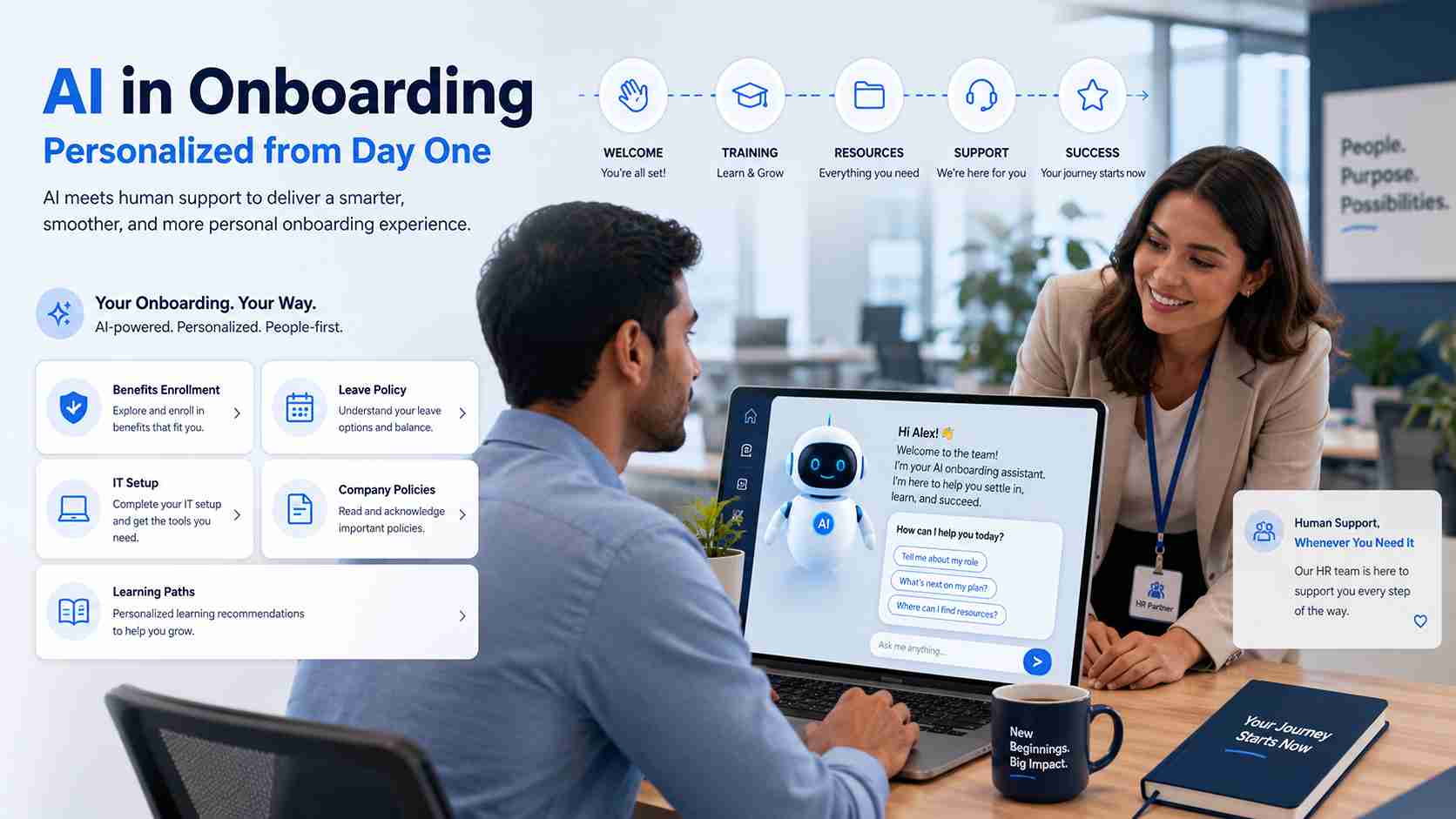
AI-powered virtual assistants and chatbots guide new employees through the information overload that typically accompanies a new role. Instead of waiting for an HR response, a new hire can instantly ask about:
Benefits enrollment deadlines
Leave and time-off procedures
IT setup and system access
Company policies and code of conduct
Training resources and role-specific learning paths
These tools are available 24/7 and can be personalized to the employee's role, department, and location. For multinational organizations, this is especially valuable it ensures consistency across geographies without overburdening local HR teams.
Beyond chatbots, AI systems now sequence onboarding tasks intelligently sending the right training module at the right time, rather than dumping everything into a new hire's inbox on day one. This staged, personalized approach improves completion rates and reduces new hire anxiety.
Employee Engagement: Understanding the Workforce at Scale
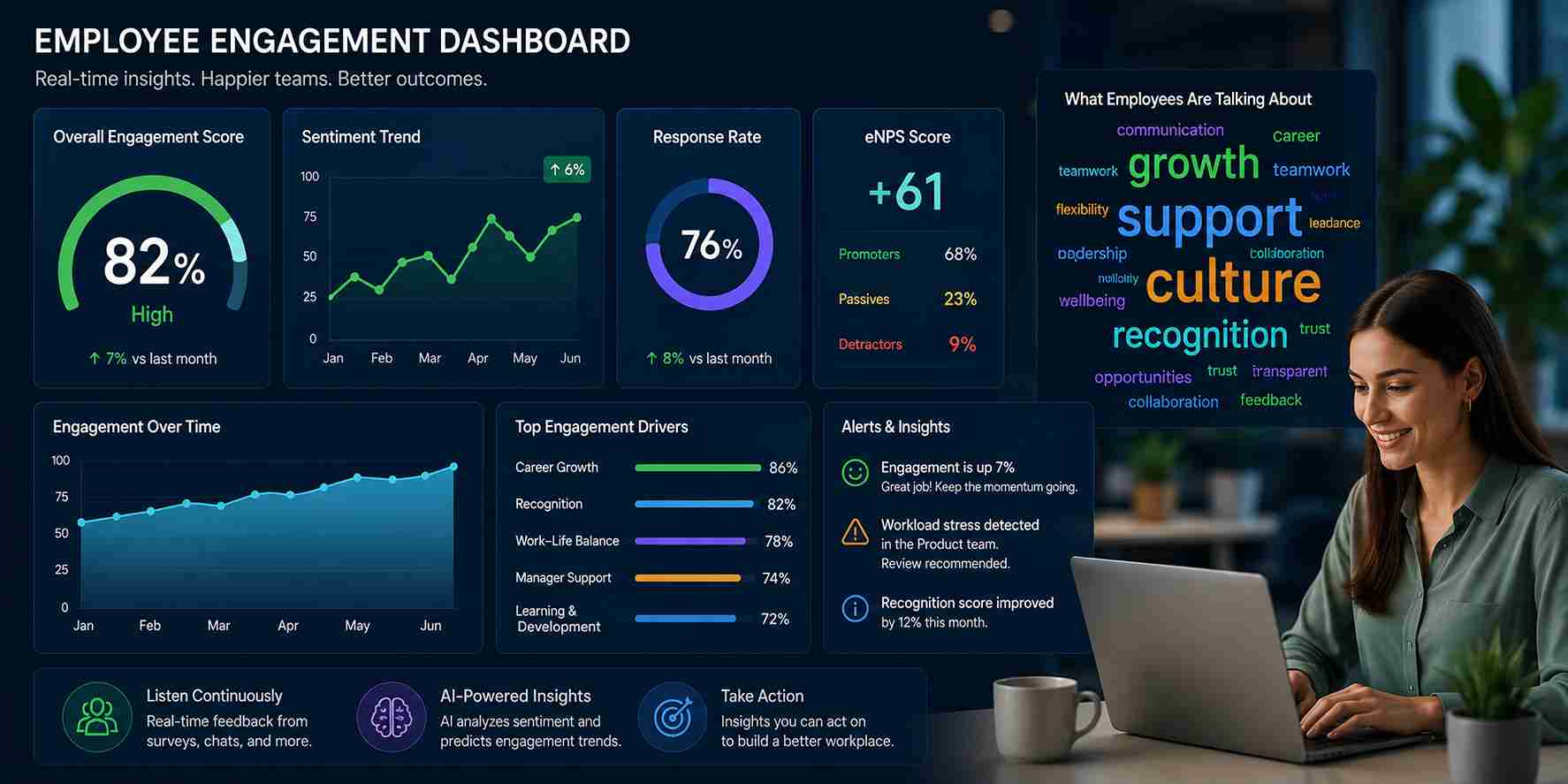
Employee engagement is one of the most strategically important and historically hard to measure dimensions of human resource management. Engagement surveys conducted once a year capture a snapshot that is often months out of date by the time anyone acts on it.
AI changes the tempo and depth of engagement measurement.
How AI Detects and Addresses Disengagement
AI-powered engagement platforms analyze multiple real-time data streams pulse surveys, anonymized communication patterns, project participation, leave data to identify early signals of disengagement or burnout before they escalate into turnover.
Patterns that AI can surface include:
Sudden decline in collaboration tool activity
Increased after-hours work suggesting unsustainable workload
Drop in voluntary participation in team initiatives
Sentiment shifts in open-ended survey responses
Clustering of disengagement signals within specific teams or managers
Armed with these insights, HR leaders and managers can intervene early with a conversation, a workload adjustment, or a targeted support initiative rather than reacting to resignation letters.
This is agentic AI at its most practically valuable: not replacing human judgment, but giving HR professionals the situational awareness to act proactively.
AI in Performance Management: Continuous, Data-Driven, Fair
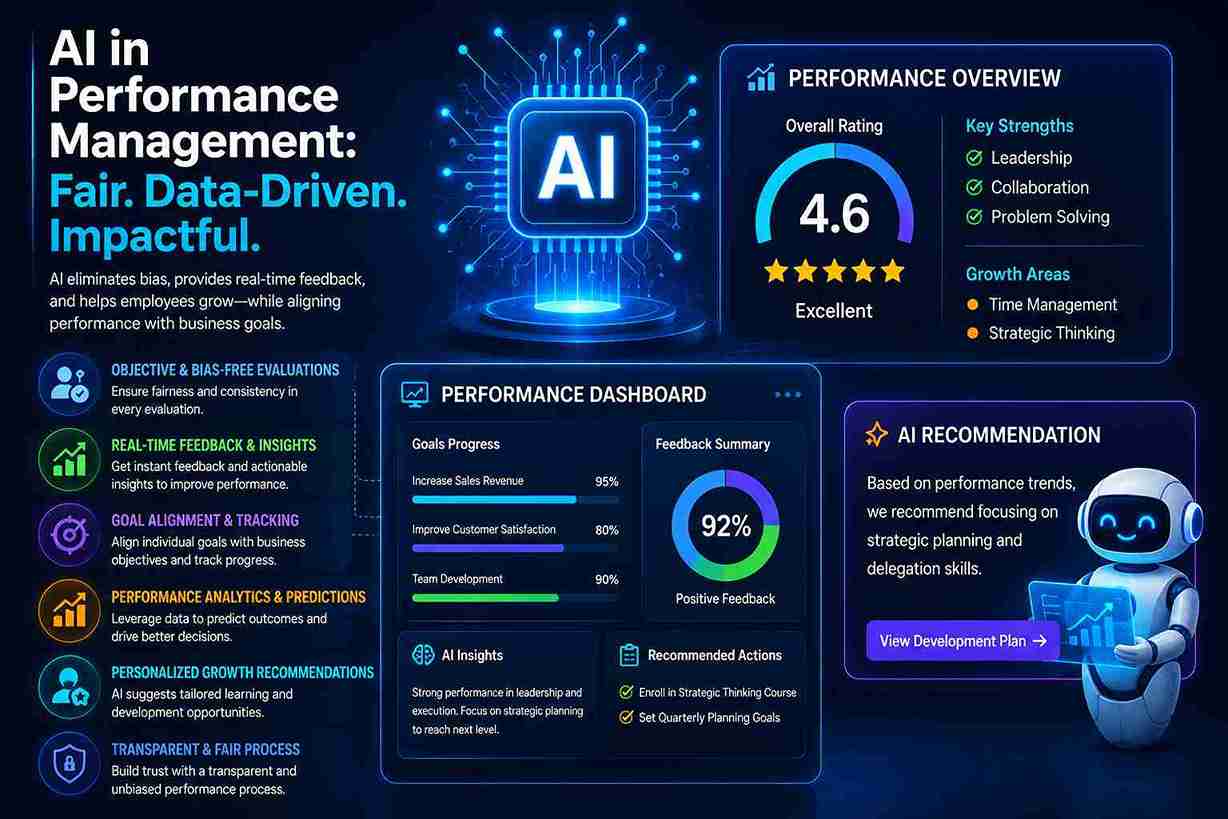
The annual performance review is, for most employees, one of the least satisfying HR experiences. It compresses a year of complex contribution into a single conversation, often colored by recency bias and manager subjectivity.
AI-driven performance management replaces this model with something far more useful.
Modern AI Performance Systems
Today's AI-powered performance tools provide:
Goal tracking in real time: employees and managers see progress against objectives continuously, not at year-end
Productivity trend analysis: identifying periods of high output and potential blockers
360-degree feedback aggregation: AI synthesizes peer, manager, and self-assessment data into coherent, actionable profiles
Personalized development recommendations: based on performance data, AI suggests specific skills, courses, or experiences to close gaps
Bias detection: algorithms flag patterns in ratings that may suggest systemic bias (e.g., demographic groups consistently rated lower by specific managers)
This data-driven approach reduces the skills gap between high-performers and the broader workforce by making development proactive rather than remedial. It also gives HR leaders objective evidence for promotion and compensation decisions reducing the political friction that often undermines fair HR operations.
Personalized Learning and Development: Closing the Skills Gap
In a rapidly changing business environment, continuous learning is no longer optional it is an operational requirement. AI in HR processes has made personalized development scalable for the first time.
How AI Powers Personalized Learning
Rather than assigning the same compliance training to every employee, AI-powered learning platforms build individualized development paths based on:
Current skill inventory and identified gaps
Role requirements and career goals
Performance data and manager feedback
Learning preferences and past completion patterns
The platform continuously updates recommendations as the employee grows. Completed a data analytics course? The AI surfaces the next logical step a project-based application, a certification, a stretch assignment.
This approach dramatically improves learning ROI. Employees engage with content that is directly relevant to their work and career trajectory. Organizations build internal capability faster and reduce reliance on external hires to fill emerging skill needs.
Workforce Planning and Predictive Analytics: Strategic HR at ScalePerhaps the most strategically significant application of AI in HR is predictive workforce analytics. Organizations can now model future talent needs with data-driven precision.
What Predictive Analytics Enables
AI analyzes historical and real-time workforce data to generate forward-looking intelligence:
Attrition risk modeling: identifying employees most likely to leave within 6–12 months
Skills gap forecasting: projecting which capabilities the organization will need 1–3 years ahead
Succession planning: mapping internal talent pipelines against future leadership needs
Hiring demand forecasting: predicting staffing needs before positions become urgent.
Workforce cost optimization: modeling the financial impact of different talent strategies
This transforms HR from a reactive function into a strategic partnerWhen the CFO asks, "Do we have enough talent for our expansion into Southeast Asia?" AI helps HR teams make decisions using real data rather than intuition.
HR Automation: Reclaiming Time for What Matters
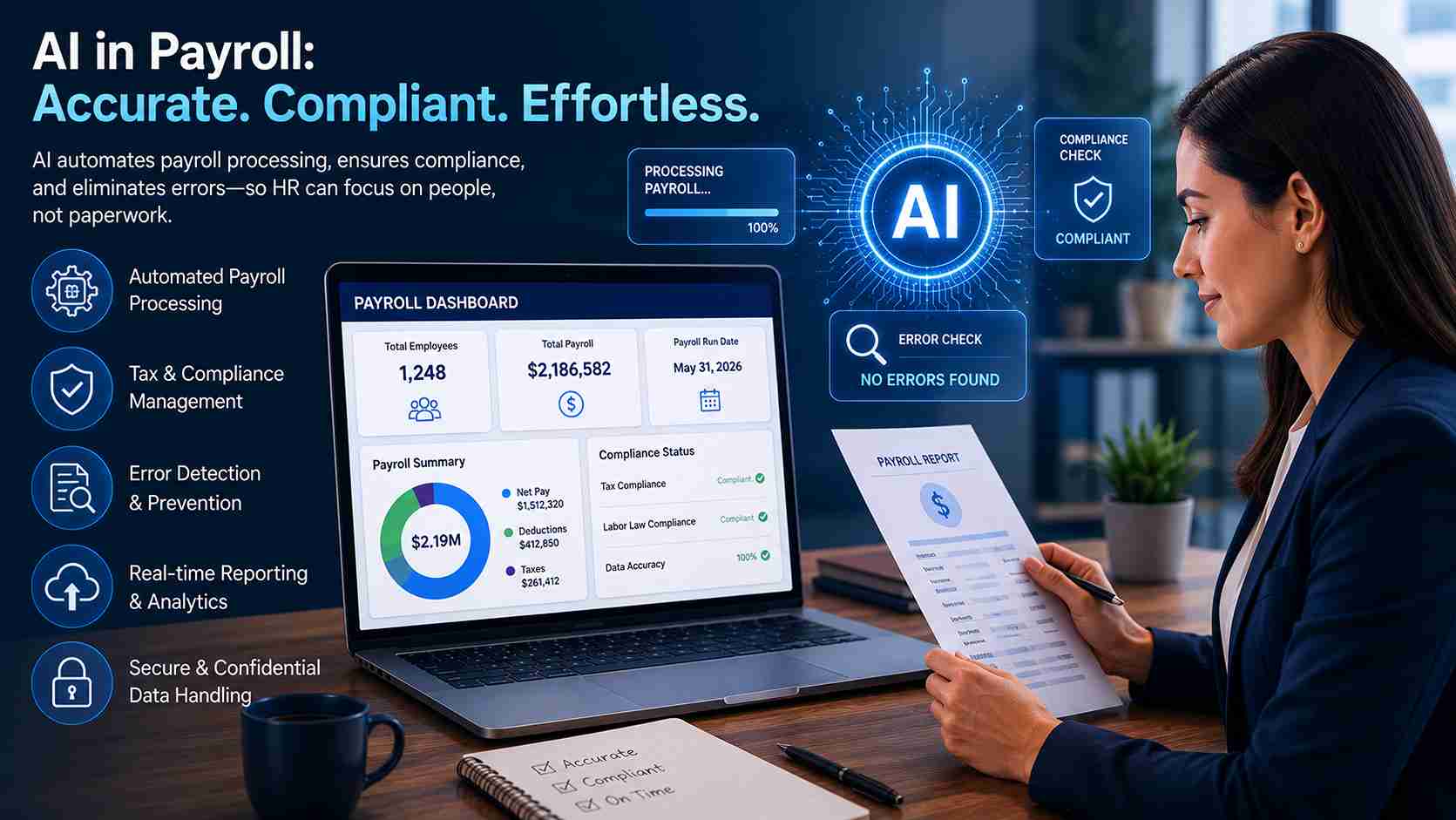
The administrative burden of HR operations has long been one of the profession's most significant frustrations. AI-powered automation is systematically eliminating this burden.
Routine tasks that AI now handles include:
Payroll processing: automated calculation, tax compliance, and disbursement
Leave management: self-service portals with AI approval logic
Attendance tracking: integrated with scheduling and payroll systems
Benefits administration: automated enrollment workflows and eligibility verification
Employee record maintenance: AI ensures data accuracy and flags anomalies
When HR professionals are freed from these routine tasks, they direct their energy toward coaching managers, designing culture initiatives, and building the kind of employee experience that distinguishes great employers from average ones.
Challenges and Ethical Considerations
Understanding how AI is changing HR processes in 2026 requires an honest accounting of its risks alongside its benefits. Algorithmic Bias
AI systems can repeat past biases if they are trained on biased historical data. If past hiring favoured certain groups, AI may repeat the same hiring patterns. Regular bias auditing, diverse training data, and human oversight are non-negotiable requirements for ethical AI in HR.
Data Privacy
HR departments handle some of the most sensitive personal data in any organization medical information, performance records, compensation data, personal communications. Implementing AI in HR processes requires robust data governance, encryption standards, and compliance with privacy regulations such as GDPR and local equivalents.
The Human Touch
Generative AI can draft job descriptions, summarize performance data, and generate personalized learning recommendations. It cannot replace empathy, contextual judgment, or the trust that develops in a genuine human relationship. The best HR teams in 2026 use AI to amplify their human capabilities not substitute for them.
The Future of HR With AI
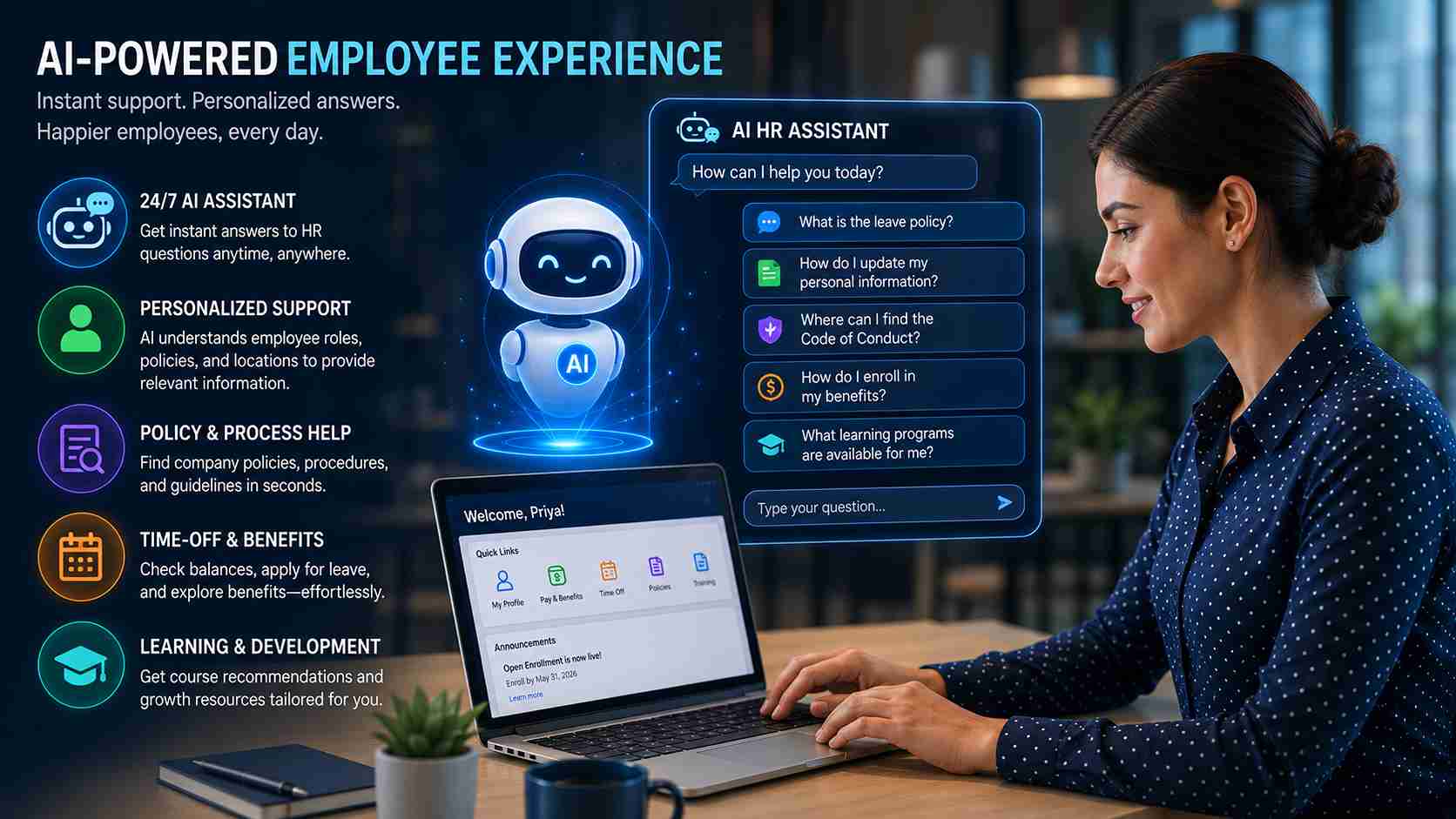
Looking ahead, the trajectory of AI in HR processes points toward even deeper integration:
Advanced virtual HR assistants that handle complex multi-step employee queries
Real-time wellness monitoring that identifies burnout risks from behavioural signals
More effective succession planning based on continuous employee network analysis.
Personalized career paths that change as employees grow
Greater agentic AI autonomy in routine HR workflows, with human review reserved for high-stakes decisions
Organizations that build AI literacy within their HR teams, invest in ethical AI governance, and maintain the human touch at every critical people moment will be best positioned for this future.
FAQ: How AI Is Changing HR Processes in 2026
1. How is AI changing HR in 2026?
AI is transforming every stage of the employee lifecycle automating routine tasks like resume screening and payroll, enabling predictive analytics for workforce planning, personalizing employee learning and development, and providing real-time insights into engagement and performance.
2. What are the main benefits of AI in HR processes?
Key benefits include faster and fairer recruitment, reduced administrative burden on HR teams, more accurate and continuous performance management, personalized employee development, and proactive identification of attrition risks.
3. What is an HR system and how does AI improve it?
An HR system (HRMS) is the technology platform that manages core HR functions—hiring, payroll, performance, and employee records. AI improves these systems by adding predictive analytics, automation, personalization, and real-time data processing.
4. What are the ethical challenges of using AI in HR?
The main challenges are algorithmic bias (AI may perpetuate historical inequities), data privacy (sensitive employee information requires strict governance), and over-automation (some people-centered decisions require human empathy and judgment).
5. Will AI replace HR professionals?
No. AI handles volume, data processing, and pattern recognition exceptionally well. HR professionals remain essential for relationship-building, ethical judgment, cultural leadership, and complex interpersonal situations that AI cannot navigate with genuine understanding.
6. What is agentic AI in HR?
Agentic AI refers to AI systems that can execute multi-step tasks autonomously—such as managing an end-to-end onboarding workflow, proactively flagging engagement risks, or autonomously scheduling interviews across complex calendars without requiring constant human input for each step.
7. How can organizations implement AI in HR responsibly?
Responsible implementation requires regular bias audits of AI systems, strong data privacy governance, transparent communication with employees about how AI is used, and maintaining human oversight for all high-stakes HR decisions.
Conclusion
How AI is changing HR processes in 2026 is one of the defining workplace stories of our era. The technology is powerful, the benefits are measurable, and the organizations that embrace AI responsibly are gaining real competitive advantages in talent acquisition, employee engagement, and workforce planning.
But the most important lesson from 2026's HR transformation is this: AI amplifies human capability it does not replace it. The future of HR belongs to teams that combine data-driven AI tools with the empathy, judgment, and relational intelligence that only people can provide.
Whether you are an HR leader evaluating your technology stack, a business owner thinking about workforce strategy, or an HR professional preparing for the next chapter of your career, the time to engage with AI in HR is now.