5 Common Recruitment Mistakes Companies Should Avoid
Every hiring cycle carries risk, and the most costly risks usually come from avoidable recruitment mistakes, not from a shortage of qualified candidates. Hiring the right person strengthens productivity, culture, and long-term business goals. Hiring the wrong person, or losing a strong candidate to a slower competitor, can cost far more than the salary itself. This guide walks through five recruitment mistakes companies repeatedly make, why they happen, and exactly how to fix them.
Why Recruitment Mistakes Cost More Than They Seem
Recruitment isn't just about filling an open seat. It's about identifying people whose skills, mindset, and potential align with where the organization is headed. When companies make hiring mistakes, the damage rarely stops at one bad hire it ripples into team performance, employee morale, and even the company's ability to attract future talent.
With competition for skilled talent increasing across nearly every industry, a slow or inconsistent hiring process doesn't just risk a wrong hire it risks losing the right one to a faster-moving competitor.
Mistake 1: Writing Unclear or Incomplete Job Descriptions
Job descriptions are often a candidate's first real interaction with a company. If the description is vague, overloaded with unnecessary requirements, or missing key details, it either scares off qualified candidates or attracts the wrong ones entirely.
A common example: a listing buries the actual purpose of the role under a long list of disconnected responsibilities, or includes "required" skills that aren't actually essential to doing the job well.
How to Fix It
A strong job description should clearly state:
Job title and department
Key responsibilities tied to real day-to-day work
Required qualifications and experience
Essential technical and soft skills
Work location and arrangement (remote, hybrid, on-site)
Salary range, where appropriate
Growth and development opportunities
The most important fix is simple: separate job requirements that are truly essential from those that are merely preferred. This one change alone reduces mismatched applications significantly.
Mistake 2: Focusing Only on Qualifications and Experience
Two candidates can have nearly identical resumes and still perform very differently on the job. Qualifications and experience matter, but they're an incomplete picture. Communication skills, adaptability, and a learning mindset often predict success just as strongly, sometimes more so, especially in fast-changing roles.
Rejecting a candidate purely because they haven't used one specific tool, despite strong problem-solving ability and a track record of learning quickly, is one of the more common hiring mistakes that quietly costs companies good talent.
How to Fix It
Evaluate candidates on a broader set of criteria, including:
Category | What to Assess |
Technical skills | Role-specific tools and knowledge |
Soft skills | Communication, teamwork, collaboration |
Adaptability | Ability to learn new systems or processes |
Attitude | Ownership, accountability, professionalism |
Potential | Leadership capacity, growth trajectory |
Structured interviews, practical skills assessment tasks, and scenario-based questions consistently produce more accurate hiring decisions than resume screening alone.
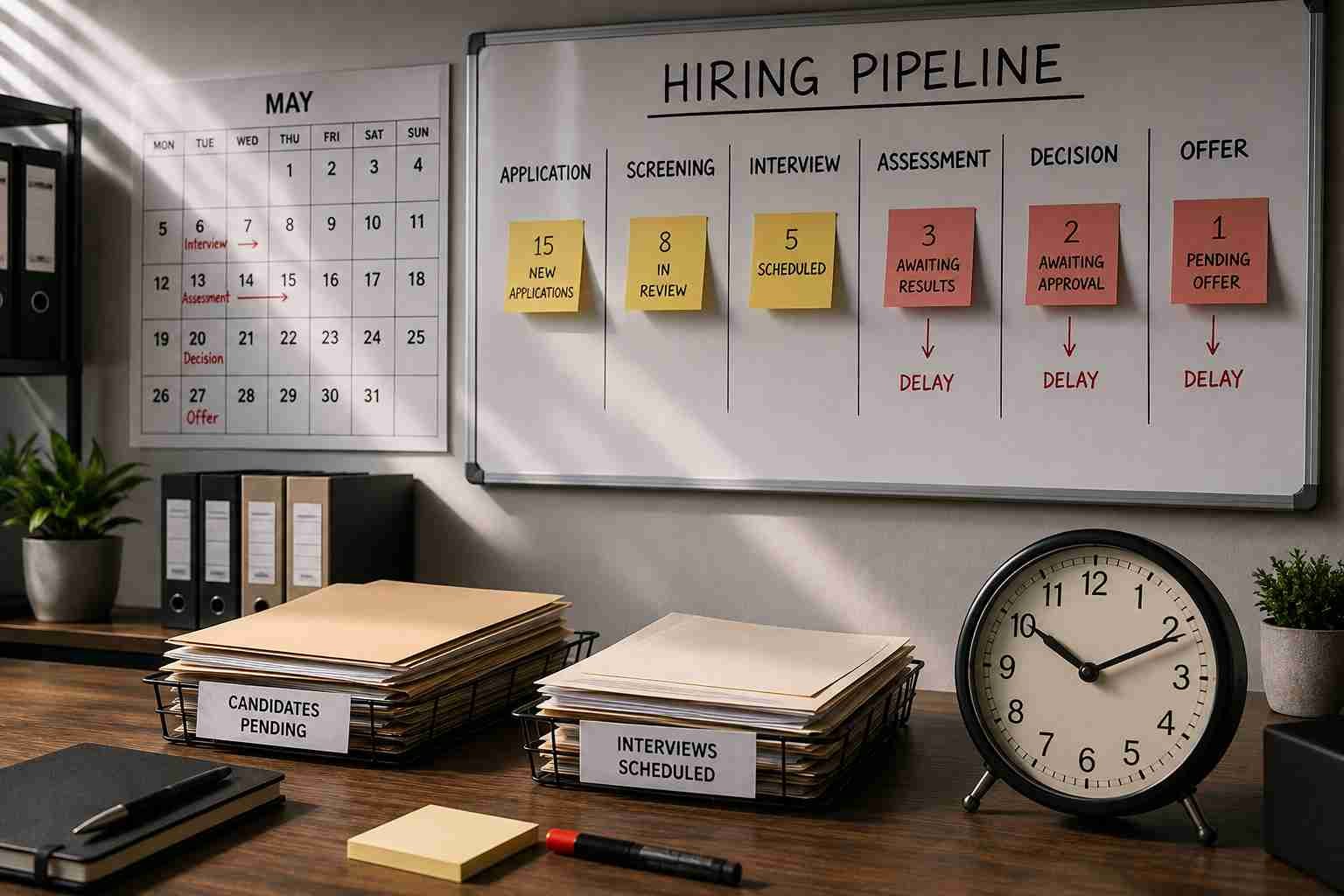
Mistake 3: Delaying the Hiring Process
A slow hiring process is one of the most damaging and most common recruitment mistakes. Strong candidates rarely wait around for one company to make up its mind; they're often interviewing elsewhere simultaneously. If a competitor moves faster, the slower organization loses the candidate, regardless of how good the offer eventually would have been.
Delays don't just cost you candidates they also signal disorganization, which can quietly damage how candidates perceive the company.
How to Fix It
Build a clear, communicated hiring timeline:
Application → Screening → Interview → Assessment → Final Interview → Decision → Offer
Even when a final decision isn't ready, a short update telling candidates the process is still moving prevents them from assuming they've been passed over. Speed doesn't mean rushing it means eliminating unnecessary gaps between stages.
Mistake 4: Providing a Poor Candidate Experience
Recruitment runs in both directions. While companies evaluate candidates, candidates are simultaneously evaluating the company and every interaction shapes that impression. A poor candidate experience includes unanswered applications, last-minute schedule changes, vague communication, or simply never informing candidates of the outcome.
Even candidates who don't get the job remember how they were treated, and that perception directly affects employer branding and future applicant interest.
 How to Fix It
Communicate clearly and promptly at every stage
Provide accurate role and process information upfront
Prepare candidates ahead of interviews
Give feedback where possible, even to unsuccessful candidates
Close out the process professionally, every time
None of this requires complex systems consistency and respect do most of the work.
Mistake 5: Hiring for Skills While Ignoring Culture Fit
Technical skill alone doesn't guarantee success. A highly qualified candidate can still struggle if their working style or expectations clash significantly with the team. This is where culture fit becomes relevant, but it's frequently misapplied.
Culture fit should never mean hiring people who all think, communicate, or work the same way. That approach quietly narrows diversity of thought and limits new ideas reaching the team.
 How to Fix It
During interviews, explore how candidates approach:
Collaboration and teamwork
Conflict resolution
Communication style
Decision-making under ambiguity
Accountability and ownership
Just as important: evaluate for culture add, not only culture fit. Candidates who bring new perspectives and skills push the team forward, not just candidates who blend in seamlessly.
How to Build a Structured Recruitment Process
Avoiding these five recruitment mistakes consistently requires more than fixing individual interviews it requires a structured recruitment process the whole hiring team follows.
A strong process typically includes:
Clear hiring requirements know exactly what the role needs before sourcing begins
Effective sourcing reach candidates through the right channels for the role
Structured screening evaluate every candidate against the same criteria
Well-planned interviews ask consistent, role-specific questions
Timely communication keep candidates informed at every stage
Objective decision-making rely on evidence, not gut feeling alone
Professional onboarding set new hires up for a smooth transition
When these steps work together, talent acquisition becomes measurably faster, fairer, and more consistent across the organization.
Direct Answer: What Are the Most Common Recruitment Mistakes?
The most common recruitment mistakes are: writing unclear job descriptions, over-relying on qualifications while ignoring soft skills and adaptability, allowing the hiring process to drag on too long, delivering a poor candidate experience, and hiring for skills alone without considering culture fit. Fixing these five areas has a direct, measurable impact on hiring quality and candidate retention through the process.
FAQ
1. What are the most common recruitment mistakes companies make? The five most common recruitment mistakes are unclear job descriptions, overemphasis on qualifications, slow hiring timelines, poor candidate experience, and ignoring culture fit in favor of skills alone.
2. How does a slow hiring process affect recruitment outcomes? A slow hiring process risks losing strong candidates to faster-moving competitors and can create the impression of disorganization, damaging the company's employer brand.
3. Why is candidate experience important in recruitment? Candidate experience shapes how applicants including those not hired perceive the company, which directly affects employer branding and future applicant interest.
4. What's the difference between culture fit and culture add? Culture fit focuses on how well a candidate aligns with existing team norms, while culture add focuses on the new perspectives and skills a candidate brings that help the team grow.
5. How can companies write better job descriptions? Separate essential requirements from preferred qualifications, clearly state responsibilities and expectations, and avoid overloading the listing with unnecessary criteria.
6. What should a structured recruitment process include? It should include clear hiring requirements, effective sourcing, structured screening, well-planned interviews, timely communication, objective decision-making, and professional onboarding.
7. How do recruitment mistakes affect business performance? Poor hiring decisions can reduce productivity, damage employee morale, and hurt team performance, while strong hiring decisions support long-term organizational growth.
Conclusion
 Recruitment mistakes are rarely the result of one bad decision they usually stem from process gaps that compound over time: vague job descriptions, slow timelines, narrow evaluation criteria, and inconsistent candidate communication. The good news is that each of these is fixable with a structured, consistent approach. If your hiring process has been losing strong candidates or producing inconsistent results, start by auditing these five areas first. The companies that hire best aren't always the fastest they're the ones that combine speed with fairness, clarity, and respect for the candidate on the other side of the process.