
How AI Is Transforming Modern Sales Processes in 2026
Selling Has Entered a New Era
Sales used to run almost entirely on instinct, relationships, and persistence. Those qualities still matter, but they no longer carry a sales team on their own. AI in sales has moved from an experimental add-on to a core part of how revenue teams operate in 2026, changing how leads are found, how deals are forecasted, and how customers are engaged at every stage of the buying journey.
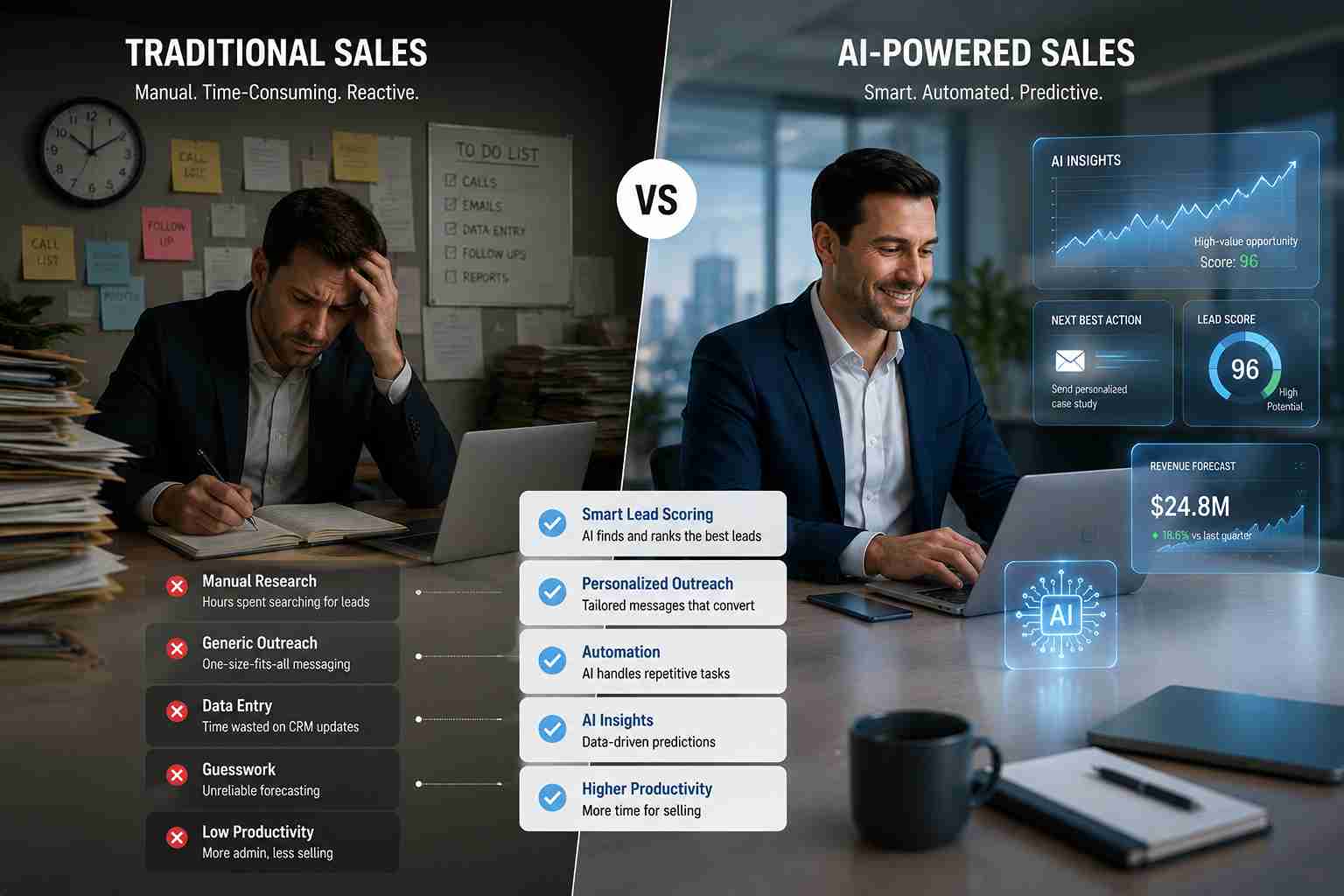 This shift isn't about replacing salespeople. It's about removing the busywork that used to eat up a rep's day so they can spend more time actually selling. Below is a practical look at what's actually changing, why it matters, and how teams can use it without losing the human touch that still closes deals.
Quick Answer: What Does AI Actually Do for Sales Teams?
If you only have thirty seconds, here's the core answer: AI in sales analyzes customer data to identify qualified leads, automates repetitive administrative tasks, personalizes outreach at scale, predicts revenue more accurately, and powers virtual assistants that handle routine customer interactions. The result is more time for reps to focus on relationship-building and closing, rather than data entry and guesswork.Why AI Adoption in Sales Accelerated
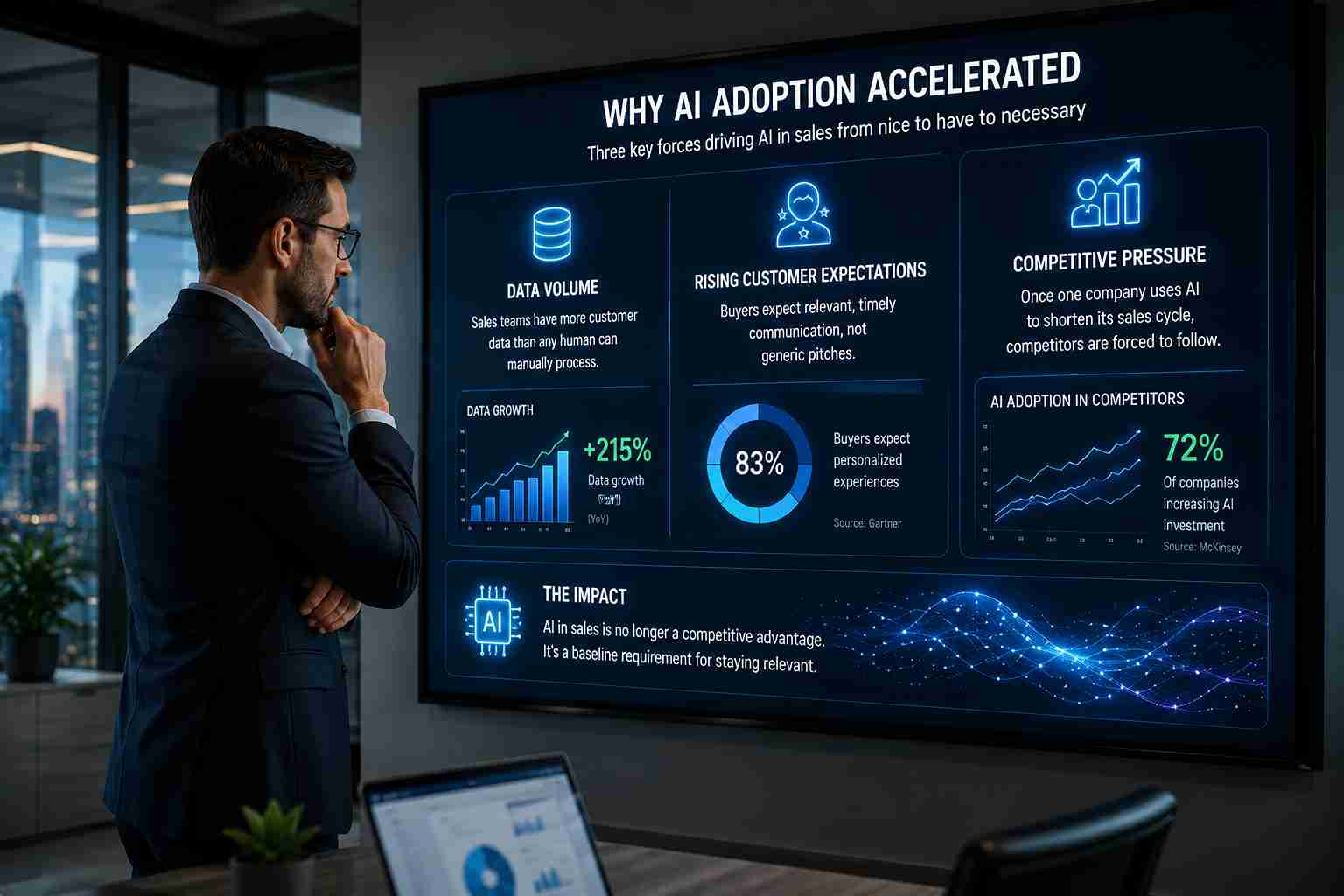 Three pressures pushed AI in sales from "nice to have" to "necessary":
Data volume. Sales teams now sit on more customer data than any human could manually process browsing behavior, email engagement, CRM history, support tickets.
Rising customer expectations. Buyers expect relevant, timely communication, not generic pitches.
Competitive pressure. Once one company in an industry uses AI to shorten its sales cycle, competitors are forced to follow or fall behind.
Data volume. Sales teams now sit on more customer data than any human could manually process browsing behavior, email engagement, CRM history, support tickets.
Rising customer expectations. Buyers expect relevant, timely communication, not generic pitches.
Competitive pressure. Once one company in an industry uses AI to shorten its sales cycle, competitors are forced to follow or fall behind.
Together, these forces have made AI in sales less of a competitive edge and more of a baseline requirement for staying relevant.
AI-Powered Lead Generation and Qualification
 Finding qualified leads has historically consumed enormous amounts of a rep's time. AI changes that by scoring and prioritizing prospects automatically based on real signals rather than gut feel.
Modern AI sales tools can:
Finding qualified leads has historically consumed enormous amounts of a rep's time. AI changes that by scoring and prioritizing prospects automatically based on real signals rather than gut feel.
Modern AI sales tools can:
Analyze online behavior and intent signals to flag prospects actively researching a solution
Score leads by conversion probability, so reps know who to call first
Continuously update lead scores as new behavior data comes in
Cut down hours spent on manual prospecting
Analyze online behavior and intent signals to flag prospects actively researching a solution
Score leads by conversion probability, so reps know who to call first
Continuously update lead scores as new behavior data comes in
Cut down hours spent on manual prospecting
This isn't just about volume it's about precision. A sales team chasing fewer, better-qualified leads typically outperforms one chasing every contact equally, which is why lead scoring has become one of the most cited use cases for AI in sales.
Personalization at Scale: Treating Every Buyer as an Individual
 Personalization at scale is one of the clearest wins AI has delivered to sales teams. Buyers today expect messaging tailored to their specific situation, not a templated pitch sent to a thousand contacts.
AI makes this possible by analyzing:
Personalization at scale is one of the clearest wins AI has delivered to sales teams. Buyers today expect messaging tailored to their specific situation, not a templated pitch sent to a thousand contacts.
AI makes this possible by analyzing:
Past purchase and browsing behavior
Stated and inferred customer preferences
Engagement history across channels
Content interactions that signal interest
Past purchase and browsing behavior
Stated and inferred customer preferences
Engagement history across channels
Content interactions that signal interest
With this data, AI systems can recommend the right product, customize email sequences, and surface content that actually matches where a prospect is in their buying journey. This kind of hyper-personalization used to require an entire team of analysts; now it runs continuously in the background.
Sales Automation Solutions: Removing the Busywork Administrative tasks remain one of the biggest drains on sales productivity. Updating records, scheduling calls, sending follow-ups none of it closes deals, but all of it has to happen. Sales automation solutions now handle much of this without manual input:
Auto-logging calls and emails into the CRM
Triggering follow-up sequences based on buyer activity
Generating sales reports without manual compilation
Scheduling meetings directly from email threads
Auto-logging calls and emails into the CRM
Triggering follow-up sequences based on buyer activity
Generating sales reports without manual compilation
Scheduling meetings directly from email threads
The practical effect is straightforward: reps get hours back in their week, and that time goes toward actual conversations instead of data entry.
AI CRM Software: From Static Database to Active Advisor
Traditional CRMs were passive they stored information and waited for someone to look at it. AI CRM software in 2026 behaves more like an active advisor.
Capability | Traditional CRM | AI CRM Software |
Data storage | Yes | Yes |
Manual data entry | Mostly required | Largely automated |
Next-best-action suggestions | No | Yes |
Churn prediction | No | Yes |
Lead prioritization | Manual | Automated scoring |
Reporting | Manual compilation | Auto-generated insights |
This shift means CRM automation isn't just about saving time on data entry it's about surfacing opportunities and risks a rep might otherwise miss, like a key account showing early signs of churn or a dormant lead suddenly re-engaging.
AI Sales Forecasting: Replacing Guesswork with Pattern Recognition
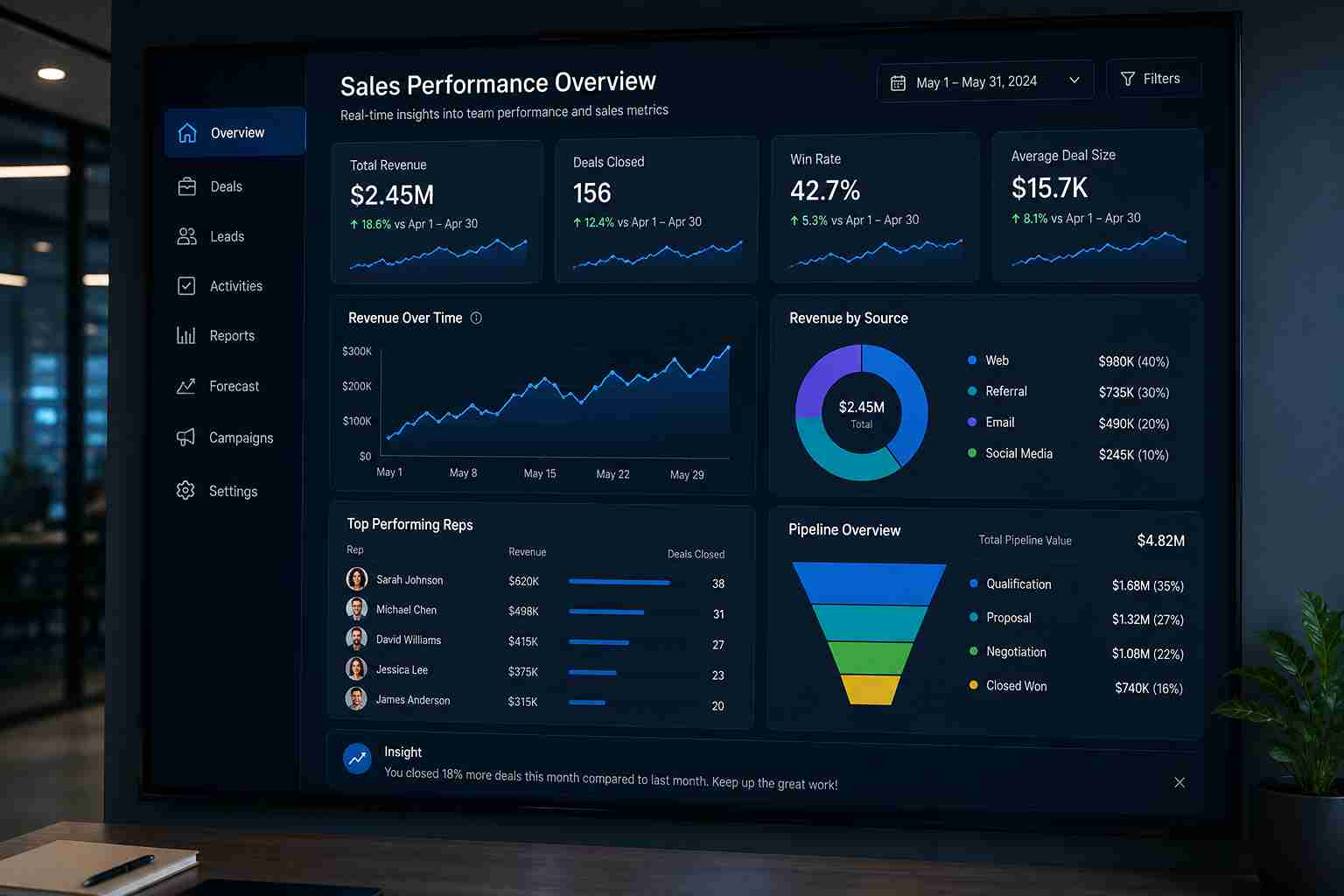 Forecasting has traditionally leaned on historical averages and a manager's intuition. AI sales forecasting takes a different approach, identifying patterns across large datasets that aren't obvious to a human analyst working from a spreadsheet.
This type of predictive sales analytics helps teams:
Forecast revenue with tighter accuracy bands
Anticipate shifts in customer demand before they show up in the numbers
Flag accounts at risk of churn
Allocate sales resources toward the highest-probability opportunities
The practical upside is that forecasting becomes less about defending a number to leadership and more about genuinely understanding where the business is headed.
Virtual Sales Assistants and Conversational AI
 A virtual sales assistant can now handle a meaningful share of front-line customer interaction without human involvement, answering product questions, qualifying leads, and booking meetings around the clock.
Common capabilities include:
A virtual sales assistant can now handle a meaningful share of front-line customer interaction without human involvement, answering product questions, qualifying leads, and booking meetings around the clock.
Common capabilities include:
Responding to common buyer questions instantly, including outside business hours
Pre-qualifying leads before they reach a human rep
Recommending products based on stated needs
Scheduling demos or calls directly within the conversation
Responding to common buyer questions instantly, including outside business hours
Pre-qualifying leads before they reach a human rep
Recommending products based on stated needs
Scheduling demos or calls directly within the conversation
AI chatbots and virtual assistants don't replace the need for human reps on complex or high-value deals, but they remove friction at the top of the funnel, which improves both customer engagement and response time.
Sales Intelligence and Performance Coaching AI is also changing how sales managers coach their teams. Sales intelligence platforms can review calls, emails, and meeting recordings to surface patterns in what separates a team's top performers from the rest.
This kind of performance analytics typically highlights:
Talk-to-listen ratios on sales calls
Objection-handling patterns that correlate with closed deals
Messaging that consistently underperforms
Coaching opportunities specific to each rep
Rather than relying solely on a manager's subjective impression of a call, teams now have data-backed feedback loops that make coaching more targeted and consistent.
Challenges That Come With AI in Sales None of this is automatic or risk-free. Teams adopting AI in sales commonly run into a few recurring issues:
Data quality. AI is only as useful as the data feeding it; messy or incomplete CRM data produces unreliable recommendations.
Privacy and security. Handling customer data responsibly is non-negotiable, both legally and ethically.
Integration complexity. Stitching AI tools into existing sales tech stacks takes real engineering effort.
Team resistance. Reps used to a particular workflow may resist new tools, especially if rollout is rushed.
Data quality. AI is only as useful as the data feeding it; messy or incomplete CRM data produces unreliable recommendations.
Privacy and security. Handling customer data responsibly is non-negotiable, both legally and ethically.
Integration complexity. Stitching AI tools into existing sales tech stacks takes real engineering effort.
Team resistance. Reps used to a particular workflow may resist new tools, especially if rollout is rushed.
Addressing these honestly, rather than glossing over them, is part of what separates a successful AI rollout from a stalled one.
Human-AI Collaboration Is the Real Story It's tempting to frame this as machines replacing people, but that's not what's actually happening. The most effective sales organizations treat AI as a layer that handles scale and pattern recognition while humans handle trust, negotiation, and judgment calls that depend on context a model doesn't have. Human-AI collaboration works best when AI takes on the repetitive, data-heavy parts of the job scoring, scheduling, drafting, forecasting and people focus on the conversations that actually require empathy and strategic thinking. That balance, not full automation, is what's driving results in 2026.
What's Coming Next Looking ahead, a few directions are becoming clearer:
More autonomous sales agents handling end-to-end qualification before a human ever steps in
Real-time buying intent analysis that updates lead priority instantly
Forecasting models that adjust continuously rather than on a monthly cycle
Deeper integration between marketing and sales data for a single view of the customer
More autonomous sales agents handling end-to-end qualification before a human ever steps in
Real-time buying intent analysis that updates lead priority instantly
Forecasting models that adjust continuously rather than on a monthly cycle
Deeper integration between marketing and sales data for a single view of the customer
Organizations that build strong data foundations now will be better positioned to take advantage of these capabilities as they mature.
FAQ Section
1. What is AI in sales? AI in sales refers to the use of artificial intelligence tools to automate, analyze, and optimize parts of the sales process, including lead scoring, forecasting, CRM management, and customer communication.
2. How does AI improve lead generation? AI analyzes behavioral and demographic data to identify which prospects are most likely to convert, allowing reps to prioritize outreach instead of contacting every lead equally.
3. Is AI sales forecasting more accurate than traditional methods? AI sales forecasting generally improves on traditional methods because it can process larger datasets and detect patterns that aren't visible through manual analysis, though accuracy still depends heavily on data quality.
4. Will AI replace sales reps? No. AI handles repetitive, data-driven tasks, but relationship-building, negotiation, and trust still depend on human judgment, which is why most successful sales teams use AI alongside reps rather than instead of them.
5. What is personalization at scale in sales? Personalization at scale means using AI to tailor messaging, recommendations, and content to individual buyers across a large customer base, rather than manually customizing outreach one contact at a time.
6. What's the difference between a regular CRM and AI CRM software? A regular CRM stores customer data for manual review, while AI CRM software actively analyzes that data to suggest next steps, predict churn, and prioritize leads automatically.
7. How do virtual sales assistants help small sales teams? Virtual sales assistants can handle initial customer questions, lead qualification, and scheduling around the clock, which is especially valuable for smaller teams that can't staff every hour of buyer activity.
Conclusion
 AI in sales isn't a future trend to prepare for it's already reshaping how lead generation, forecasting, CRM management, and customer engagement work in 2026. The organizations seeing the biggest gains aren't the ones that automated everything; they're the ones that used AI to clear out repetitive work so their people could focus on the parts of selling that still depend on human judgment and trust.
If your sales process still relies on manual prospecting, static reporting, or generic outreach, that's the clearest signal it's time to evaluate where AI sales tools could fit into your workflow, starting with the bottleneck that costs your team the most time today.
AI in Web Development: How Smart Websites Help Businesses Grow in 2026
How AI Is Changing HR Processes in 2026
How We Helped a Client Redesign Their Brand Under Extreme Time Constraints
Recruitment in 2026: The Major Shift Toward a Human-Centric Talent Strategy