Google Ads vs Facebook Ads: Which Is Better for Your Business in 2026?
Choosing between Google Ads and Facebook Ads is not as simple as it sounds. Both platforms command billions in global ad spend every year and for good reason. Google processes over 8.5 billion searches daily, while Meta's platforms reach more than 3 billion active users. Choosing the wrong one or ignoring the other entirely can silently drain your advertising budget without delivering results.
This guide breaks down every critical difference between the two platforms: audience intent, cost per click, targeting depth, lead quality, return on ad spend (ROAS), and which industries benefit most from each. Whether you're a business owner, a marketing manager, or a startup founder deciding where to put your first ₹50,000, this is the comparison you need in 2026.
What is pay-per-click advertising, and how does each platform use it?
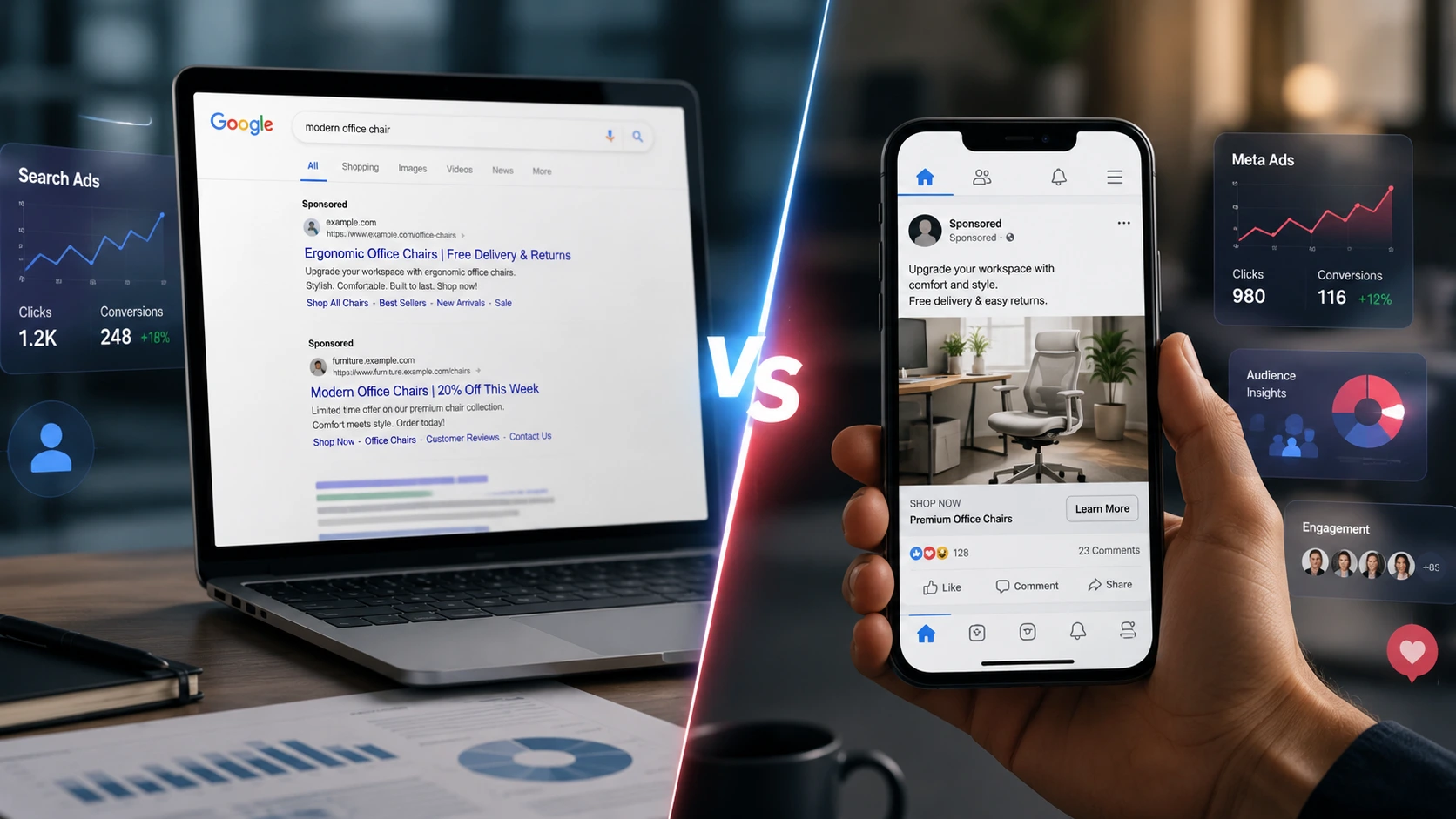
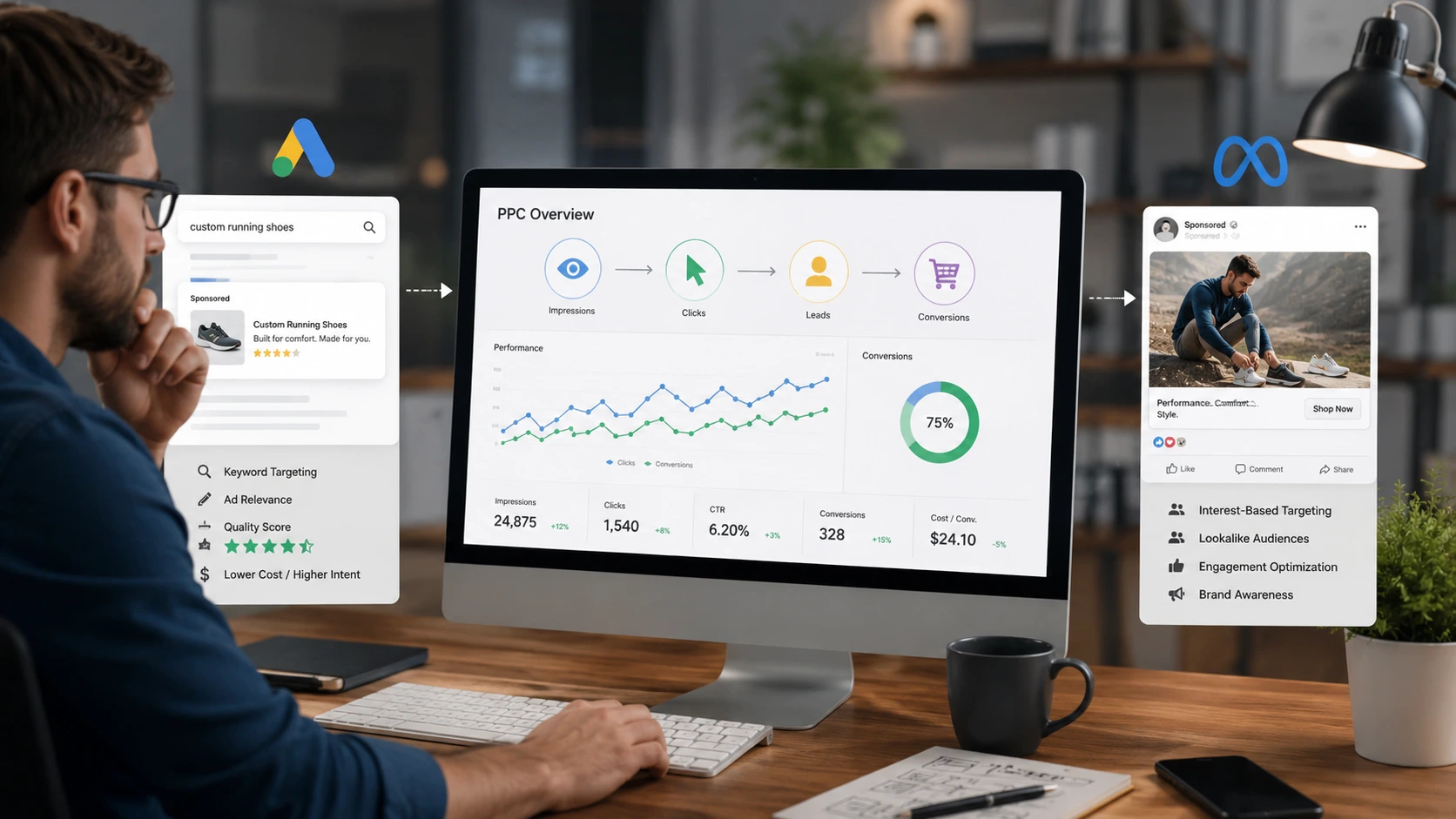
Before comparing platforms, it helps to understand what is pay per click advertising. PPC is a digital advertising model where you only pay when someone clicks your ad, not when it's shown. Both Google and Facebook offer PPC-style pricing, but they apply the model differently.
Google Ads charges you primarily when a user clicks a search ad or a display ad. You bid on keywords, and your ad appears when people search for those exact terms. The platform rewards relevance through a "Quality Score," which factors in your ad copy, landing page experience, and expected click-through rate (CTR). A high Quality Score lowers your cost per click and improves ad position simultaneously.
Facebook Ads can run on a cost per click (CPC), cost per impression (CPM), or cost per lead (CPL) model. Because users aren't searching for anything they're scrolling Facebook uses interest-based targeting, behavioural signals, and lookalike audiences to decide who sees your ad. You're reaching people before they have a search query; you're creating the desire, not fulfilling it.
Quick definition: Google Ads = intent-based marketing (capturing demand). Facebook Ads = interest-based marketing (creating demand). The most successful advertisers in 2026 do both The fundamental difference: intent vs interest
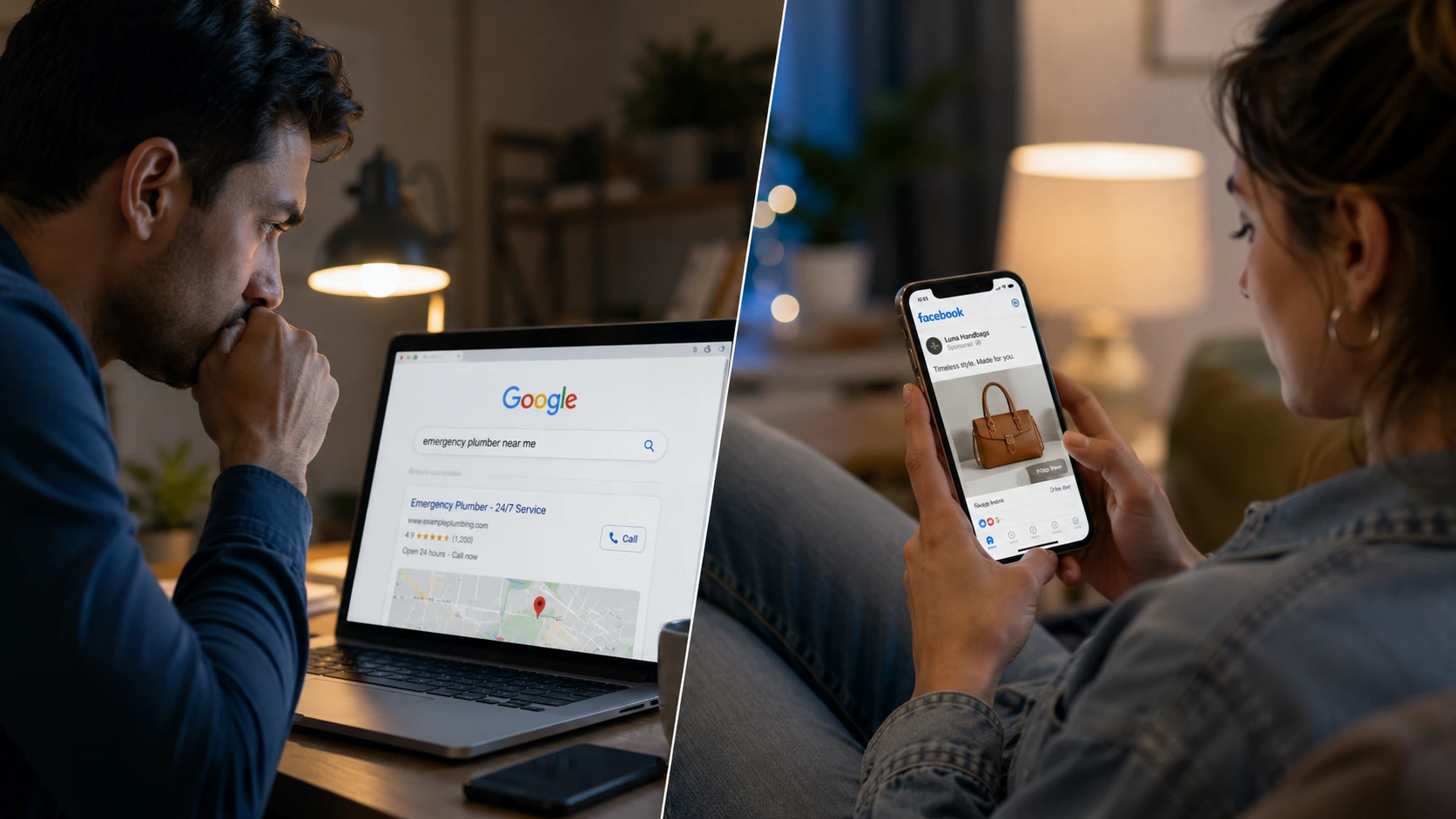
The single most important concept in Google Ads vs Facebook Ads is the difference between purchase intent and interest targeting.
When someone types "emergency plumber in Hyderabad" into Google, they are actively looking for a solution. Their wallet is metaphorically open. Google Ads puts your business directly in front of that buyer at the exact moment of need. This is why Google Search campaigns typically deliver higher ad conversion rates and lower cost per lead for service-based businesses.
Facebook works the other way. A person scrolling through their Instagram feed didn't wake up thinking about a new skincare product, but a well-crafted video ad can spark curiosity, build trust, and drive a purchase days or weeks later. Facebook excels at discovery, storytelling, and nurturing audiences through the top and middle of the funnel.
Pay-per-click advertising rates: what does each platform actually cost?
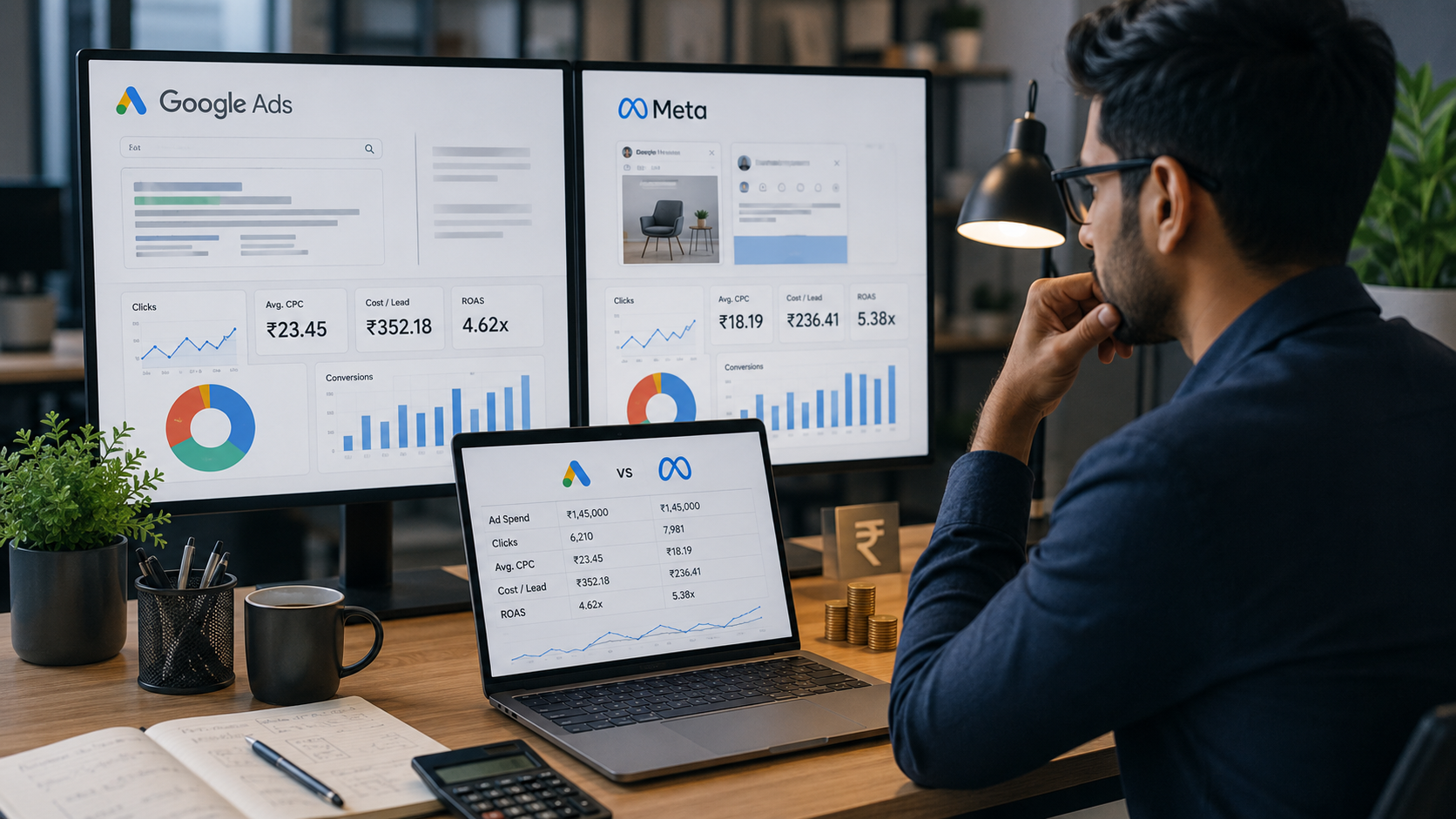
One of the most searched questions marketers ask is about pay-per-click advertising rates in India and globally. Here’s a practical breakdown based on 2025–2026 industry trends.
Metric | Google Ads | Facebook / Meta Ads |
Average CPC (India, general) | ₹20 – ₹200+ | ₹5 – ₹50 |
CPC in competitive niches (legal, finance, real estate) | ₹200 – ₹1,200+ | ₹30 – ₹150 |
Average CPM (cost per 1,000 impressions) | ₹80 – ₹400 | ₹50 – ₹200 |
Average cost per lead (B2B / service) | ₹500 – ₹3,000 | ₹200 – ₹1,500 |
Minimum ad spend to test effectively | ₹15,000 – ₹30,000/month | ₹8,000 – ₹20,000/month |
Facebook Ads typically offer lower pay per click advertising rates, making them more accessible for startups and small businesses. However, a lower CPC doesn't always translate to better return on ad spend it depends heavily on lead quality, sales cycle length, and your offer.
Head-to-head comparison: 8 critical factors
 1. Audience targeting
Google Ads targets via keyword intent, location, device, language, and remarketing lists. It's precise for demand capture but less granular on demographics.
Facebook Ads offers targeting by age, gender, interests, income tier, purchasing behaviour, job title, relationship status, and lookalike audiences built from your existing customer data. This depth makes Facebook extraordinarily powerful for niche consumer products.
2. Lead quality and conversion rate
Google Ads leads tend to convert faster because users are already in a buying mindset. The average ad conversion rate on Google Search is 3–5% across most industries significantly higher than cold social traffic. Facebook leads often require more nurturing, follow-up emails, and retargeting touchpoints before conversion.
3. Brand awareness and visual creativity
Facebook Ads supports video, Reels, carousels, Stories, and collection ads a creative canvas that Google's predominantly text-based search ads simply cannot match. Facebook and Instagram are the best platforms for building brand awareness and emotional connection. Google's Display Network and YouTube ads do support visuals, but they're typically less immersive than Meta's native formats.
4. Return on ad spend (ROAS)
ROAS depends heavily on the industry and the funnel stage. Broadly: Google Ads produces stronger ROAS for high-intent, transactional services. Facebook Ads produces stronger ROAS for consumer goods, fashion, beauty, and lifestyle products, where visual storytelling drives impulse purchases.
5. Remarketing and retargeting
Both platforms offer powerful retargeting. Google's remarketing lists for search ads (RLSA) let you adjust bids for users who've previously visited your site. Meta's Pixel tracks users across Facebook and Instagram, enabling highly personalised retargeting sequences. In 2026, with privacy changes limiting third-party cookies, first-party data lists have become critical on both platforms.
6. A/B testing capabilities
Facebook Ads Manager has built-in A/B testing tools that make it easy to split-test audiences, creatives, and placements simultaneously. Google Ads offers experiments for campaign-level tests. Both support rigorous A/B testing ads, though Facebook's interface is generally more intuitive for creative testing.
7. Conversion tracking and analytics
Google Ads integrates natively with Google Analytics 4, Google Tag Manager, and Google Merchant Centre. Conversion tracking is highly granular. Facebook uses its Pixel and Conversions API for server-side tracking, which has become more reliable since iOS 14 privacy changes. Both require proper setup to measure ad conversion rates accurately.
8. Ease of use and learning curve
Facebook Ads Manager is generally considered more beginner-friendly. Google Ads has a steeper learning curve. Keyword match types, Quality Score optimisation, bidding strategies, and Google Search Network vs Google Display Network decisions require more technical understanding.
Factor | Google Ads | Facebook Ads | Winner |
Purchase intent | High | Low–Medium | |
Audience targeting depth | Moderate | Very High | |
Average CPC (India) | Higher | Lower | |
Lead quality | Higher | Medium | |
Brand awareness | Moderate | Excellent | |
Ad conversion rate | Higher | Medium | |
Creative flexibility | Limited | Excellent | |
Remarketing | Excellent | Excellent | Tie |
B2B suitability | Strong | Moderate | |
eCommerce / consumer goods | Strong | Very Strong |
Which platform is right for your business type?
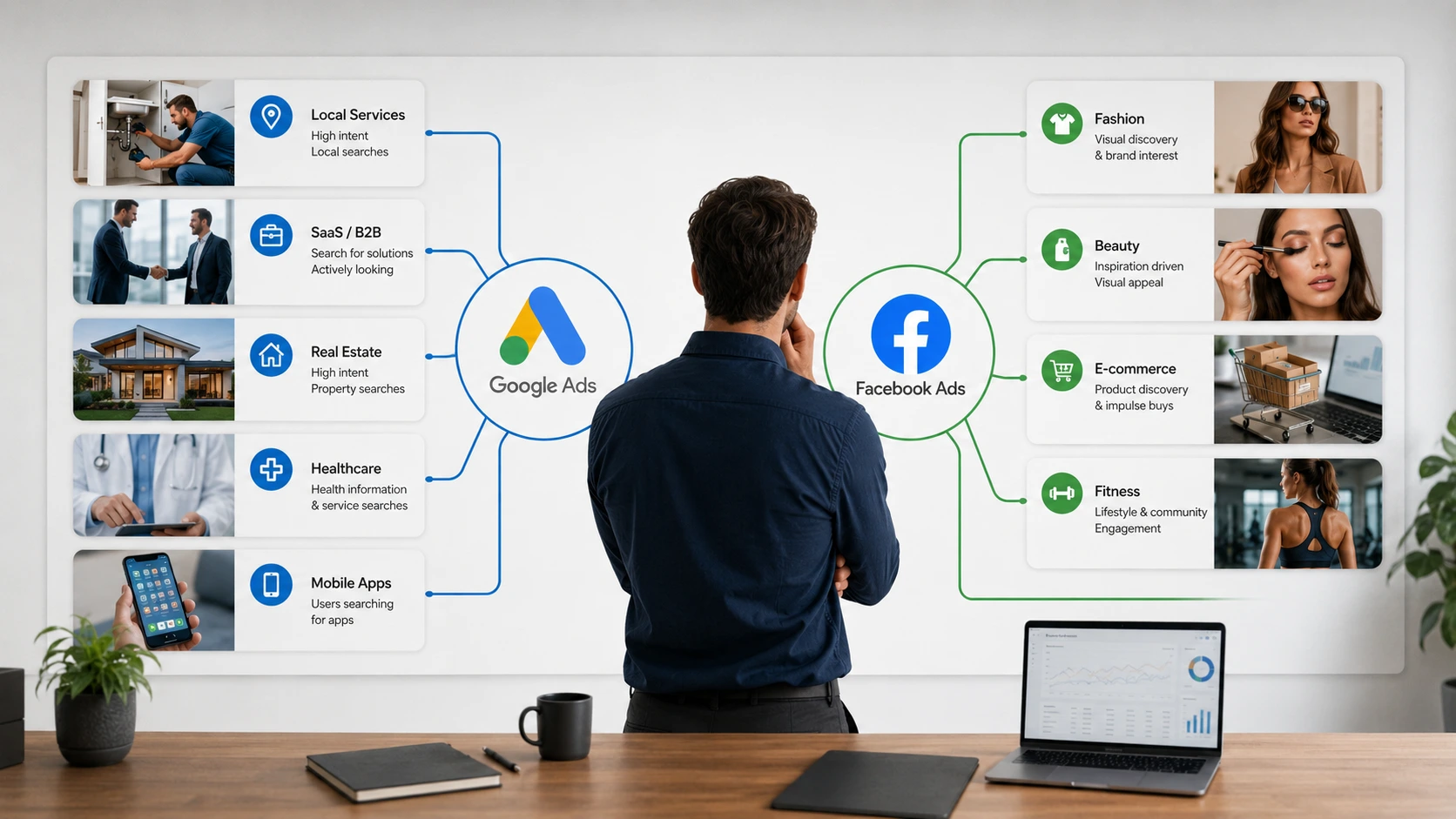 Best on Google Ads
Local service businesses (dentists, plumbers, lawyers)
SaaS and software companies
B2B lead generation
High-value, low-volume services
Real estate (active buyers)
Healthcare and clinics
Best on Facebook / Meta Ads
Fashion, beauty, and lifestyle brands
eCommerce product launches
Mobile apps and games
Fitness, wellness, and coaching
Event promotion
Consumer subscription products
For most eCommerce businesses and real estate companies, running Google Ads vs Facebook Ads as an "either/or" decision is a strategic mistake. These platforms work best as complementary layers of the same marketing funnel.
The combined strategy: how smart businesses use both in 2026
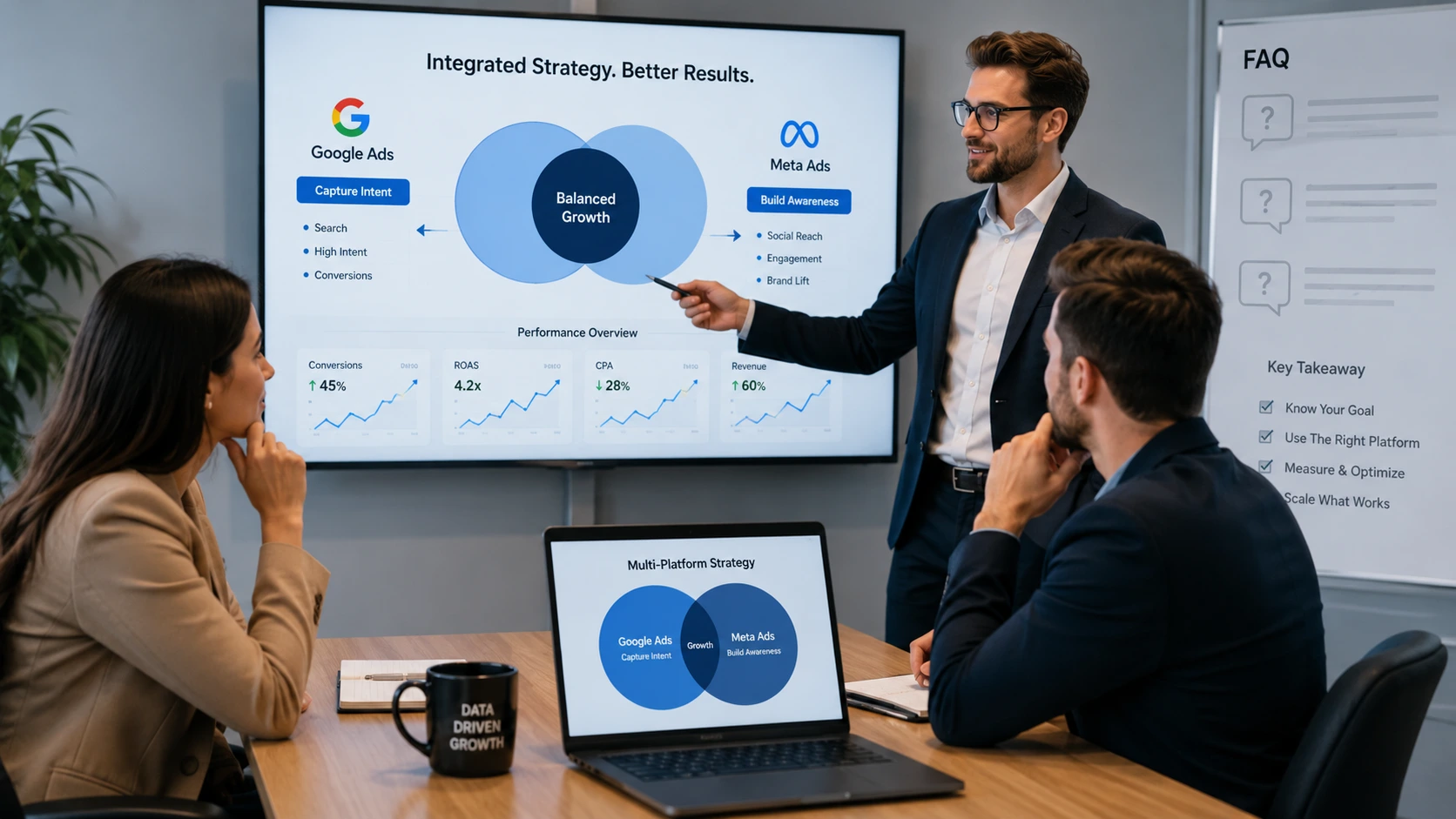
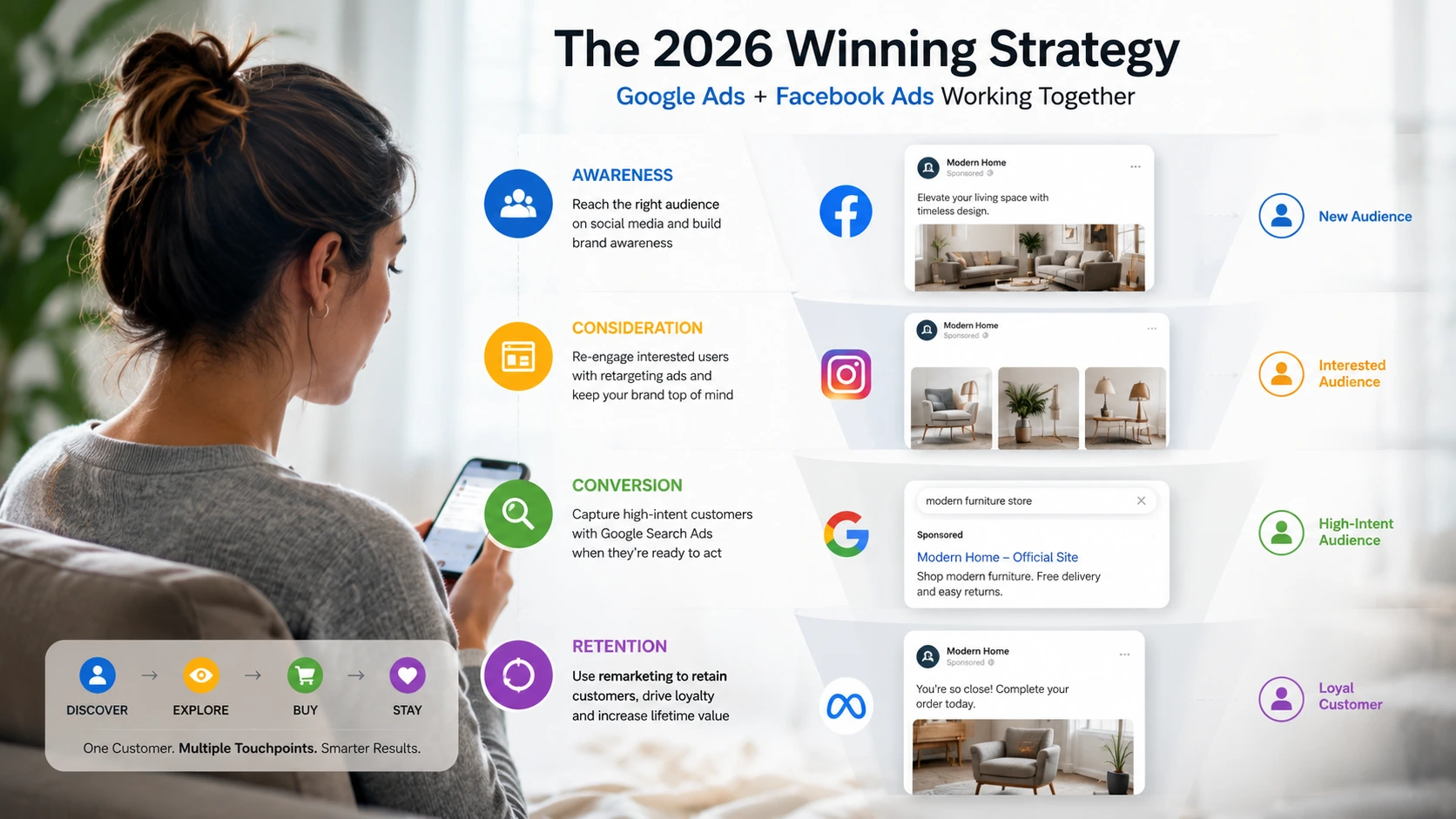 The most effective advertisers don't ask "Google Ads or Facebook Ads?" They ask, "How do I use both together?"
A practical integrated funnel looks like this: Facebook and Instagram ads introduce your brand to cold audiences at the top of the funnel (awareness). Retargeting campaigns on Meta re-engage users who visited your site or watched your videos (consideration). Google Search Ads then capture those same users when they're ready to buy and type your category keywords into Google (conversion). Finally, remarketing on both platforms nurtures existing customers toward repeat purchase (retention).
This approach maximises visibility at every stage of the customer journey. Facebook creates the demand. Google captures it. Together, they cover the full funnel.
2026 trends shaping both platforms
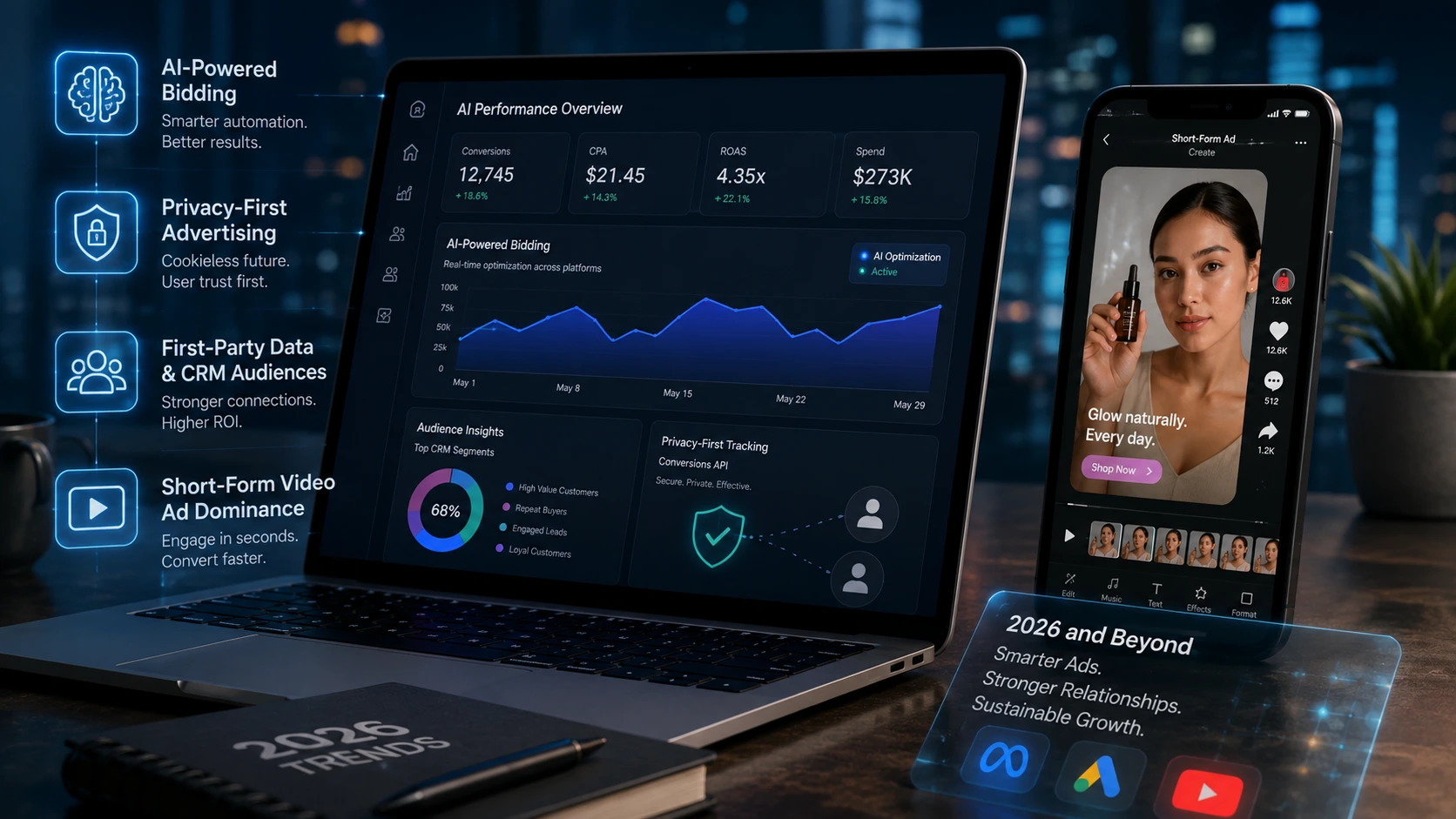 The digital advertising landscape in 2026 looks meaningfully different from even two years ago. Three trends are reshaping how Google Ads vs Facebook Ads decisions are made:
AI-powered bidding: Both platforms now rely heavily on machine learning for Smart Bidding and Advantage+ campaigns. Manual keyword-level bidding is increasingly giving way to automated strategies that optimise for ROAS or conversion value in real time.
Privacy-first advertising: With third-party cookies largely deprecated, first-party data email lists, CRM audiences, and server-side conversion tracking have become the most valuable assets in performance marketing. Businesses that built clean data pipelines early are seeing significantly better targeting accuracy.
Short-form video dominance: Reels on Instagram and Facebook, alongside YouTube Shorts, now represent some of the highest-engagement ad placements on both platforms. Video-first creative is no longer optional for consumer-facing brands.
Common mistakes businesses make when choosing between platforms
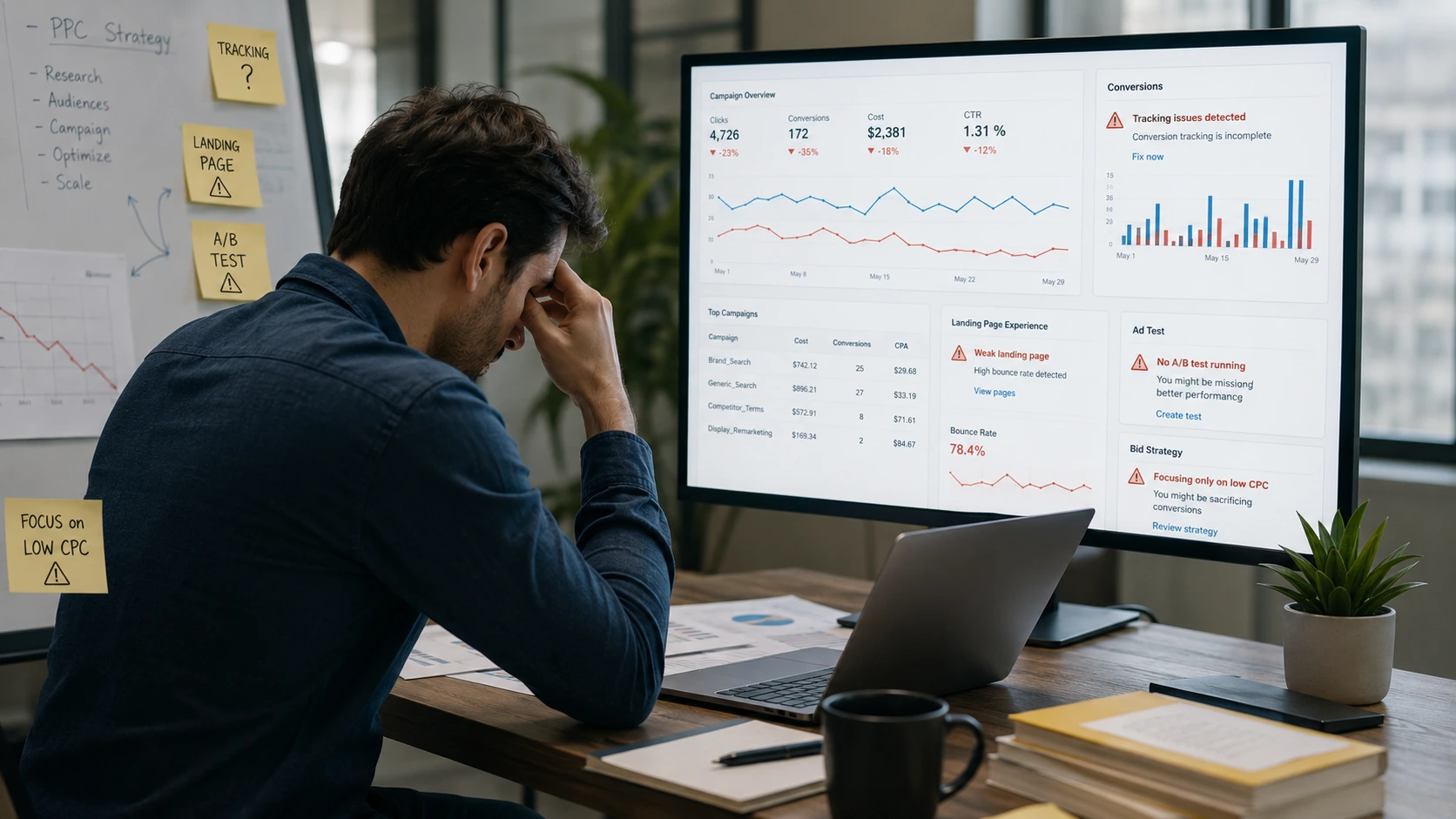
Assuming a lower CPC on Facebook automatically means better ROI, cost per lead and lead quality matter more than raw click cost.
Running Google Search Ads without a properly optimised landing page, high-intent traffic converts poorly on slow or irrelevant pages.
Ignoring conversion tracking setup without accurate data, neither platform can optimise effectively.
Choosing one platform permanently, most markets benefit from at least testing both before committing budget.
Skipping A/B testing ads creative fatigue is real on both platforms, and regular testing of headlines, images, and CTAs is essential for sustained performance.
Frequently asked questions
Is Google Ads better than Facebook Ads for lead generation?
For most service-based businesses, yes. Google Ads captures users who are actively searching for a solution, which means higher purchase intent and faster conversion cycles. Facebook Ads can generate high volumes of leads but typically requires more nurturing before conversion.
What are the average pay-per-click advertising rates in India in 2026?
On Google Ads, average CPC in India ranges from ₹20 to ₹200 for general industries, rising to ₹500–₹1,200+ in competitive sectors like legal, finance, and real estate. Facebook Ads typically run ₹5–₹50 CPC for most categories, making it more affordable for budget-conscious advertisers.
Can I run Google Ads and Facebook Ads at the same time?
Absolutely, and for most businesses, this is the recommended approach. Using both creates a full-funnel strategy: Facebook builds awareness and retargets visitors, while Google captures high-intent buyers when they're ready to convert.
Which platform offers better audience targeting?
Facebook Ads offers significantly deeper audience targeting, including interest layers, behavioural signals, income tiers, and lookalike audiences built from your customer data. Google Ads excels at keyword intent targeting but has less demographic granularity.
Which platform is better for small businesses with a limited budget?
Facebook Ads generally allow meaningful testing with a lower minimum ad spend (₹8,000–₹20,000/month vs ₹15,000–₹30,000/month for Google). However, local service businesses often see faster ROI on Google Ads due to purchase intent, even at higher CPC rates.
What is the difference between Google Search Network and Google Display Network?
The Google Search Network shows text ads to people actively searching for your keywords on Google.com. The Google Display Network places banner and image ads across millions of partner websites. Search ads have higher intent; Display ads are better for retargeting and brand awareness at a lower CPM.
How do I measure return on ad spend (ROAS) on both platforms?
Set up conversion tracking on Google Ads via Google Tag Manager and link it to Google Analytics 4. On Facebook, implement the Meta Pixel plus the Conversions API for server-side tracking. ROAS = (Revenue generated ÷ Ad spend) × 100. Most healthy eCommerce campaigns target a ROAS of 3x or higher.
Conclusion
The debate around Google Ads vs Facebook Ads in 2026 isn't really a debate; it's a question of strategy. Google Ads is the right tool when demand already exists, and you need to capture buyers at the moment of highest intent. Facebook Ads is the right tool when you need to create demand, build brand recognition, and reach highly specific audiences with compelling creative.
For businesses with the budget to use both, do it. The combination of intent-based and interest-based marketing is the most complete advertising strategy available. Facebook fills your funnel from the top. Google harvests it at the bottom. When implemented together with proper conversion tracking, A/B testing, and landing page optimisation, the results consistently outperform either platform in isolation.
Start with the platform that best matches your immediate business goal. Test rigorously. Measure return on ad spend, cost per lead, and ad conversion rate not just cost per click. And as your budget grows, build the integrated funnel that covers every stage of the customer journey.