Agile Software Development: Benefits for Growing Businesses
Introduction: Why Agile Is the Growth Engine Modern Businesses Need
If your software projects are consistently running over budget, missing deadlines, or launching features nobody asked for, your development model is the problem, not your team.
Agile software development was built to fix exactly that.
In an era where customer expectations shift overnight and markets pivot in weeks, rigid development cycles are a liability. Growing businesses from early-stage startups to scaling SaaS companies need a development approach that moves as fast as they do. Agile software development delivers that speed, flexibility, and focus.
This guide breaks down what agile actually means in practice, how it compares to traditional methods, and why its benefits directly translate into business growth, not just better code.
 What Is Agile Software Development?
Agile software development is an iterative, collaborative approach to building software that prioritises working deliverables over exhaustive documentation, customer feedback over rigid contracts, and adaptability over fixed plans.
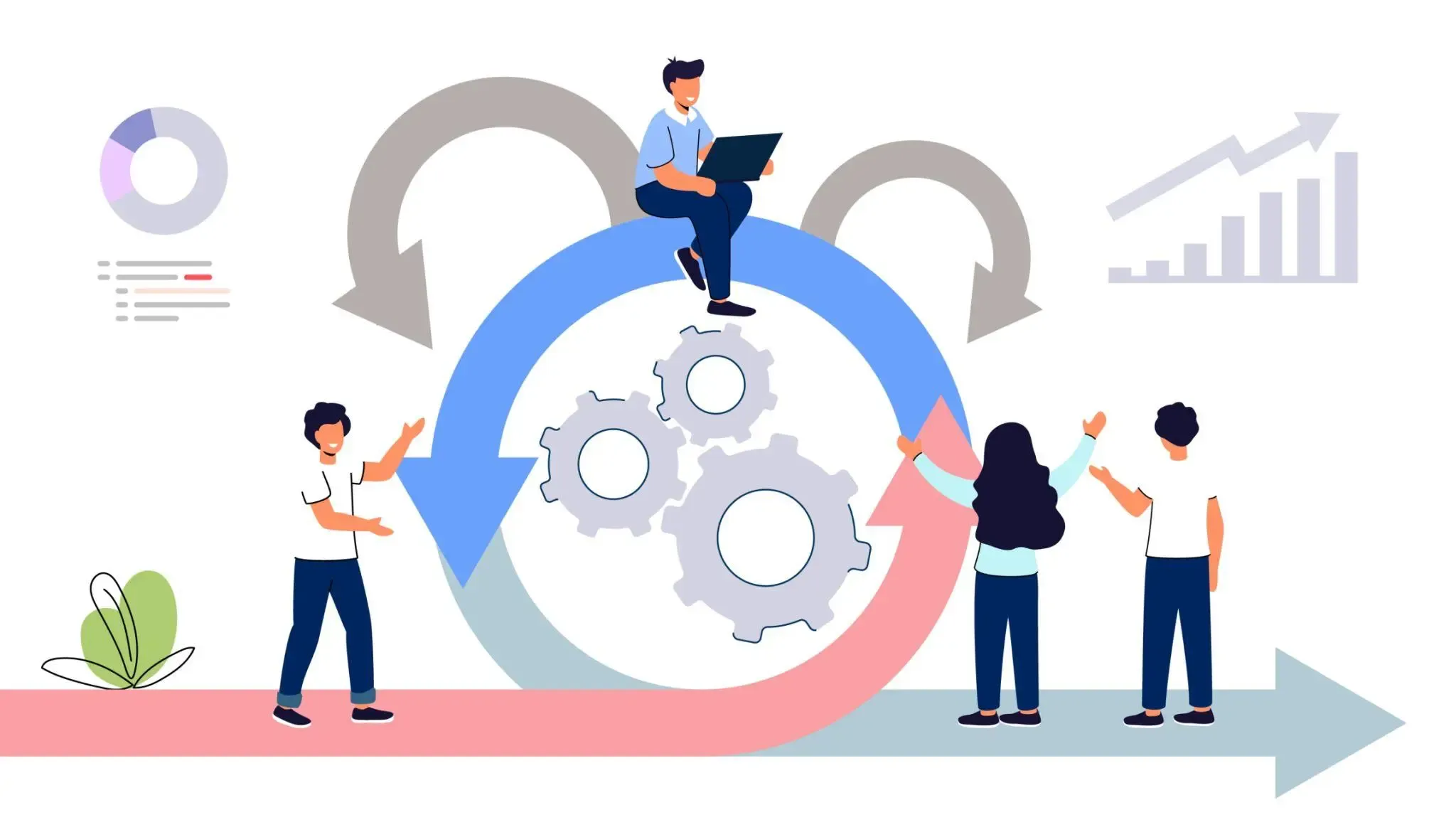
Rather than attempting to map every feature of a product before writing a single line of code, agile teams work in short, focused cycles called sprint cycles, typically one to four weeks long. At the end of each sprint, a working piece of software is delivered, reviewed, and refined based on real feedback.
The agile development model in software engineering was formally introduced through the Agile Manifesto in 2001, authored by seventeen software practitioners who recognised that traditional project management was failing the industry. Its four core values are:
Individuals and interactions over processes and tools
Working software over comprehensive documentation
Customer collaboration over contract negotiation
Responding to change by following a plan
These aren't abstract ideals. They directly shape how teams plan, build, and deliver software every day.
Agile vs Traditional Software Development: A Clear Comparison
Understanding agile development vs waterfall is essential for any business evaluating its development strategy.
The waterfall model, the most common traditional approach, moves through sequential phases: requirements → design → development → testing → deployment. Each phase must be completed before the next begins. On paper, it looks organised. In practice, it creates major problems:
Requirements gathered months ago may no longer reflect current business needs
Bugs are discovered late, making them expensive to fix
Customers see nothing until the product is "finished" often after a year or more
Changing direction mid-project requires restarting entire phases
Agile software development solves these problems by replacing linear phases with iterative cycles.
Factor | Agile Development | Waterfall Development |
Delivery | Continuous, incremental releases | Single release at project end |
Flexibility | High changes welcomed anytime | Low changes are costly mid-project |
Customer Involvement | Continuous throughout development | Mainly at the start and end |
Risk Management | Risks identified and resolved in each sprint | Risks accumulate until late testing |
Testing | Ongoing during every sprint | Concentrated at the end |
Visibility | High stakeholders see progress regularly | Low progress is mostly internal |
Best For | Dynamic, evolving projects | Fixed-scope, well-defined projects |
For most growing businesses operating in competitive, fast-changing markets, the agile development model in software engineering is the clear winner.
The Core Benefits of Agile Software Development:
1. Faster Time-to-Market Without Sacrificing Quality
Speed is a competitive advantage. One of the most cited benefits of agile software development is its ability to accelerate product delivery without cutting corners on quality.
Because agile teams work in sprint cycles, functional features ship continuously rather than accumulating in a queue until a theoretical "launch date." A business building an eCommerce platform, for example, can release core browsing and checkout functionality in the first few sprints, gathering real customer data while checkout optimisation, personalisation, and integrations are developed in parallel.
This incremental release model means:
Faster response to market opportunities
Early revenue generation, even while the product evolves
User feedback informs what gets built next, not guesswork
The software development lifecycle (SDLC) under agile is shorter per cycle, but each cycle produces measurable output. That's a fundamentally different rhythm than waiting twelve months to ship a product that may already be outdated.
2. Genuine Flexibility When Business Needs Change
Here's a scenario almost every business faces: six weeks into a six-month development project, a competitor launches a key feature, or a customer calls with an insight that changes your product strategy entirely.
In waterfall, this is a crisis. In agile development in software engineering, it's just the next sprint planning meeting.
Agile's sprint-based planning means the product roadmap is a living document, not a locked contract. Priorities can shift, features can be added or removed, and teams can pivot direction without scrapping months of work. This flexibility is precisely why we use agile methodology in software development in environments where the destination is known, but the route may change.
For growing businesses, especially SaaS startups, this flexibility can decide whether a product succeeds or fails.
3. Continuous Testing = Higher Software Quality
Traditional development treats testing as a phase. Agile treats it as a habit.
In agile and scrum methodology, continuous testing is baked into every sprint. Developers write and test code simultaneously, automated testing catches regressions early, and quality assurance runs alongside feature development not after it.
The practical impact
Bugs are found early, when they take hours instead of weeks to fix.
Performance issues are identified before they reach users
Security vulnerabilities are addressed sprint-by-sprint rather than discovered post-launch
Automated testing pipelines ensure regressions don't sneak through as the codebase grows
The result is software that is more stable, more secure, and more reliable at launch and remains that way as it scales.
4. A Genuine Client Feedback Loop (Not Just Check-Ins)
One of the most undervalued benefits of agile software development is how it systematically embeds the client feedback loop into the development process itself.
At the end of every sprint, stakeholders review what the team has built. They can say "this works," "this needs adjustment," or "we need to reprioritise entirely." That feedback immediately shapes the next sprint.
Compare this to waterfall, where clients are consulted at the beginning and the end. By the time feedback arrives, so much code has been written that making changes is prohibitively expensive.
Agile's feedback cycle is particularly powerful for:
Custom software development projects where requirements evolve as users interact with early prototypes
Enterprise software solutions where internal stakeholders have complex, competing needs
Healthcare software development where regulatory and clinical requirements may shift during build
5. Reduced Development Risk at Every Stage
Risk in software development typically compounds silently. Requirements misalign, technical debt accumulates, integrations fail, and none of it surfaces until the final testing phase, when it's too late and expensive to fix cleanly.
Agile development vs waterfall shows its greatest advantage here. Because each sprint ends with a working, tested product increment, risks are surfaced and resolved continuously rather than stockpiling until the end.
Key risk-reduction mechanisms in agile include:
Sprint retrospectives, teams review what worked and what didn't, improving the next cycle
Incremental budgeting spending is reviewed at each phase rather than committed upfront
Early technical spikes, complex or uncertain features, are prototyped before full development begins
DevOps integration, automated deployments, and early detection of integration issues.
For growing businesses managing tight budgets and ambitious timelines, this proactive risk management is invaluable.
6. Better Developer Collaboration and Team Transparency
Agile and scrum methodology creates a culture of daily accountability through structured communication: daily stand-ups, sprint planning, sprint reviews, and retrospectives. These aren't bureaucratic meetings, they're short, focused rituals that keep everyone aligned.
Developer collaboration improves because:
Blockers surface daily, not after they've cost a week
Cross-functional teams (design, development, QA, product) work in parallel rather than sequential handoffs
Project transparency means everyone, including non-technical stakeholders, can track progress visually through sprint boards and velocity metrics
7. Scalability Built Into the Process
Business scalability isn't just about infrastructure, it's about whether your development process can absorb more users, more features, and more complexity without breaking down.
Agile scales because:
Teams can be added or restructured between sprints
The modular nature of sprint-based feature development means new capabilities can be layered onto existing systems cleanly
DevOps integration supports continuous deployment pipelines that handle scale without manual intervention
Documentation and sprint artefacts create institutional knowledge that survives team changes
Whether you're building a SaaS platform development product serving 100 users or 100,000, an agile development model grows with you.
Popular Agile Methodologies Explained
Scrum: The Most Widely Used Agile Framework
Kanban: Continuous Flow Over Fixed Sprints
Scrum is the most prevalent implementation of agile and scrum methodology. It organizes work into defined sprints, assigns roles (Product Owner, Scrum Master, Development Team), and uses structured artifacts like the product backlog and sprint backlog to manage priorities.
Core Scrum events:
Sprint Planning: defining what will be built this sprint
Daily Stand-up: 15-minute sync on progress and blockers
Sprint Review: showing completed work to stakeholders.
Sprint Retrospective: reviewing team process, not just output
Scrum works best for teams building complex products with evolving requirements which describes most growing businesses.
Kanban focuses on visualising workflow using a task board with columns (typically: To Do → In Progress → Done). Unlike Scrum, Kanban doesn't use fixed sprints work flows continuously based on team capacity.
Kanban is ideal for:
Support and maintenance teams handling unpredictable workloads
Teams that prefer continuous delivery over sprint-based releases
Organisations that want to improve without restructuring their entire process
Lean Software Development: Maximising Value, Minimising Waste
Lean software development applies manufacturing efficiency principles to software. Its core goal: eliminate everything that doesn't add direct value to the user or the business.
Lean's seven principles include eliminating waste, amplifying learning, deciding as late as responsibly possible, and delivering fast. Lean software development is often combined with Scrum or Kanban to create leaner, more efficient agile teams.
The Agile Development Lifecycle: Step by Step:
Understanding agile development in software engineering means understanding its lifecycle as a continuous loop, not a one-way path.
Requirement Planning: Define business goals, user stories, and success criteria
Product Roadmap Creation: Prioritise features and set sprint milestones
Sprint Planning: Select backlog items for the next sprint cycle
Development + Continuous Testing: Build and test simultaneously
Client Review and Feedback: Demonstrate sprint output to stakeholders
Bug Fixing and Optimisation: Address issues before the next sprint begins
Deployment: Release completed features to users
Retrospective: Analyse what worked; improve the next sprint
This cycle repeats continuously. There is no "finished" in agile, only the next improvement.
Industries Where Agile Software Development Delivers the Most Value
Agile software development is not sector-specific, but some industries have adopted it with exceptional results:
Healthcare software development: Patient portals, EHR systems, and telemedicine platforms require continuous compliance updates and rapid UX iteration
FinTech: Regulatory changes and security patches require frequent, reliable releases
eCommerce platform development: Seasonal demand, A/B testing, and conversion optimization demand constant iteration
SaaS platform development: Subscription products live or die by feature velocity and churn reduction
Enterprise software solutions: Large organizations use agile to modernize legacy systems incrementally without full system shutdowns
Web application development: Browser compatibility, API integrations, and user expectations evolve constantly
The Future of Agile: AI, Automation, and DevOps

The next generation of agile software development is being shaped by three forces:
AI-powered software development tools like GitHub Copilot, automated code review platforms, and AI-assisted testing are accelerating sprint velocity by handling repetitive development tasks, enabling smaller teams to deliver at the pace of much larger ones.
DevOps integration has turned continuous deployment into a reality. Infrastructure-as-code, containerization, and CI/CD pipelines mean that code tested in a sprint can be live in production within minutes of approval.
Data-driven sprint planning uses historical velocity metrics and predictive analytics to improve sprint planning accuracy, reducing over-commitment and under-delivery, the two most common sprint failures.
For businesses undergoing digital transformation, investing in agile capability now means building the organizational muscles to absorb and leverage these advances as they mature.
FAQ: Agile Software Development
1. What is agile software development in simple terms?
Agile software development is a way of building software in short cycles (called sprints) where teams deliver working features regularly, gather feedback, and continuously improve. Instead of building everything at once, you build, learn, and iterate.
2. Why do companies use agile methodology in software development?
Companies use agile because it reduces risk, accelerates delivery, and keeps the product aligned with real user needs. It allows businesses to adapt to changing requirements without restarting development from scratch.
3. What is the difference between agile development vs waterfall?
Waterfall is a sequential process where each phase must finish before the next one starts. Agile is iterative development, testing, and feedback happen in overlapping sprint cycles. Agile is faster to adapt; waterfall is more predictable for fixed-scope projects.
4. What are the main benefits of agile software development?
The primary benefits include faster time-to-market, better software quality through continuous testing, reduced development risk, genuine client involvement, improved team collaboration, and the flexibility to adapt when business priorities shift.
5. What is the difference between Scrum and Kanban in agile?
Scrum uses fixed-length sprints with defined roles and ceremonies. Kanban uses a continuous flow model with a visual board and no fixed sprint cadence. Scrum suits product development teams; Kanban suits support and operations teams.
6. Is agile suitable for small businesses and startups?
Yes, agile is especially well-suited to startups and small businesses because it requires less upfront planning, reduces wasted development on the wrong features, and delivers working software quickly enough to validate ideas before over-investing in them.
7. How does lean software development differ from agile?
Lean software development is a philosophy focused on eliminating waste and maximizing value delivery. Agile is a methodology with specific frameworks (Scrum, Kanban) and practices. Lean principles often inform and improve agile implementations, and many teams combine both.
Conclusion: Agile Is Not a Trend, It's a Competitive Standard
The question is no longer whether agile software development is effective. Decades of industry evidence, countless successful products, and the near-universal adoption by leading technology companies have settled that debate.
The real question is whether your business is ready to fully use it.
For growing businesses, agile development in software engineering offers something rare: a methodology that genuinely scales with you. It delivers faster, reduces risk, responds to change, and keeps your product aligned with what your customers actually want, not what you assumed they wanted six months ago.
Whether you're building a web application, scaling a SaaS platform, modernizing enterprise systems, or embarking on a full digital transformation, agile provides the framework to do it with confidence.
The best time to adopt agile was at your last project kickoff. The second-best time is your next one.