Why Clinical Research Companies Need Custom Enterprise Applications
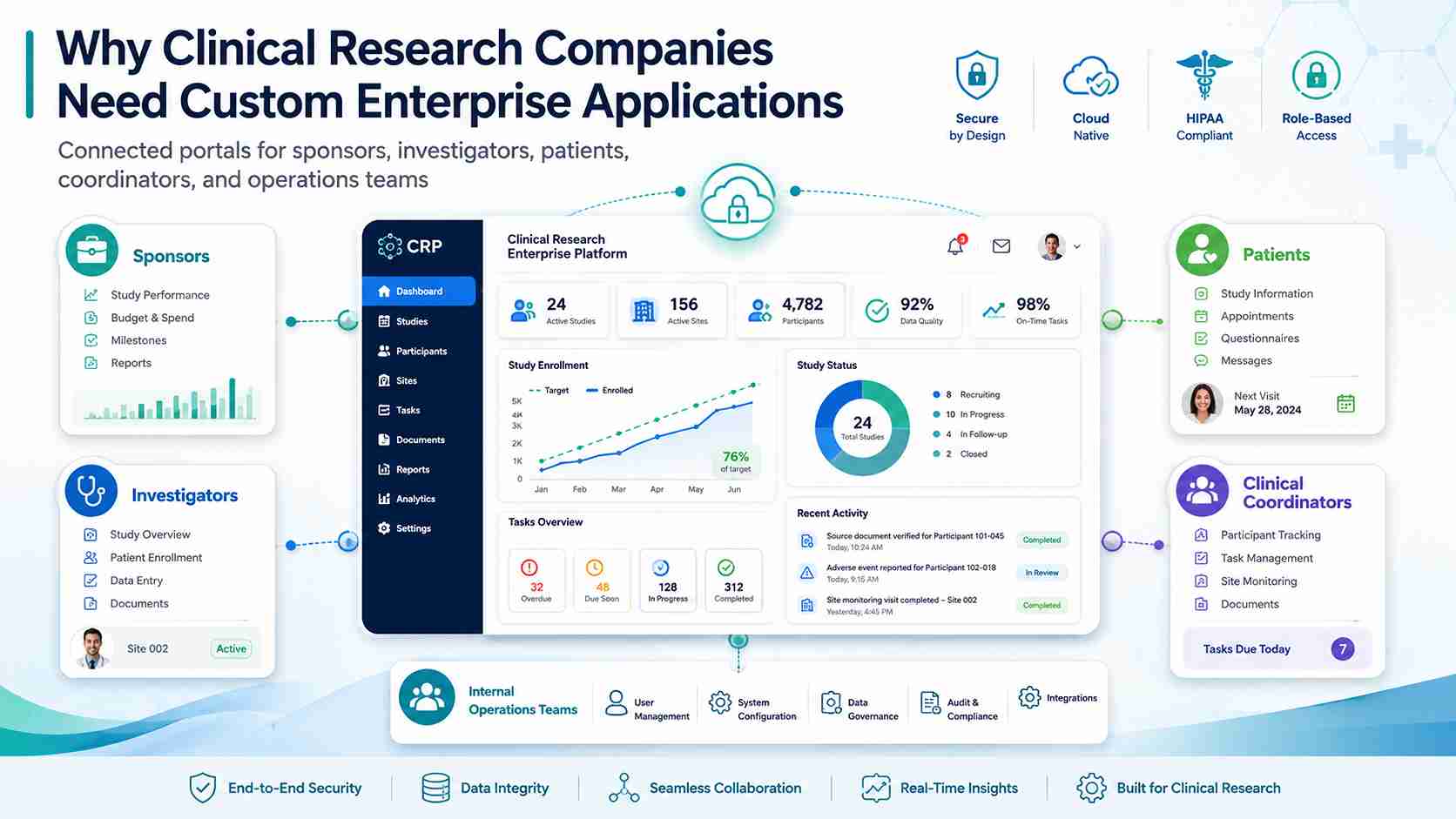
Clinical research companies manage highly sensitive, time-critical, and compliance-driven operations. Every clinical trial involves multiple stakeholders, including sponsors, investigators, patients, coordinators, site teams, data teams, compliance teams, finance teams, and internal management.
When these teams depend on Excel files, emails, manual follow-ups, disconnected systems, and scattered documents, the entire clinical trial process becomes slower and riskier. Important updates may be missed, patient follow-ups may get delayed, documents may go out of version control, and management may struggle to get real-time visibility.
This is where custom enterprise applications become highly valuable.
A custom enterprise application is not just a software tool. It is a centralized digital system designed according to the exact workflow of the clinical research company. It helps manage trial operations, stakeholder communication, patient journeys, document tracking, data visibility, compliance, approvals, reporting, and internal productivity from one secure platform.
For clinical research organizations, CROs,hospitals, pharma partners, and trial sponsors, custom enterprise applications can improve efficiency, transparency, compliance, and decision-making across the complete research lifecycle.
1. The Operational Complexity of Clinical Research
 Clinical research is not a simple business process. It includes multiple activities happening at the same time:
Study planning
Site selection
Patient recruitment
Eligibility screening
Consent management
Visit scheduling
Investigator coordination
Document collection
Protocol tracking
Adverse event reporting
Sponsor reporting
Compliance monitoring
Payment and invoice tracking
Internal review and approvals
If these activities are handled manually, teams quickly lose control over timelines, ownership, and accuracy.
For example, a coordinator may be following up with patients through phone calls, an investigator may be updating data separately, the sponsor may be asking for reports through email, and the internal management team may be checking progress through spreadsheets. This creates communication gaps and repeated manual work.
A custom enterprise application brings all these workflows into a single structured platform.
It allows clinical research companies to define roles, track activities, automate reminders, monitor progress, store documents, and generate reports without depending on scattered manual systems.
2. Why Generic Software Is Not Enough
Many clinical research companies start with generic tools such as spreadsheets, project management apps, shared drives, CRM tools, or basic document management systems. These tools may help in the early stage, but they are not designed for clinical trial operations.
Generic tools usually fail because they do not understand the specific needs of clinical research.
Clinical research requires:
Study-wise data management
Protocol-specific workflows
Site-wise tracking
Patient visit schedules
Consent document handling
Role-based access
Audit trails
Version control
Regulatory documentation
Sponsor-specific reporting
Investigator-specific communication
Secure patient data handling
A generic application cannot properly manage these requirements without heavy manual effort.
For example, a normal CRM may manage leads, but it may not manage patient eligibility, consent forms, visit completion, dropout status, protocol deviations, and investigator review. Similarly, a regular document storage system may store files, but it may not track document expiry, approval status, version history, or audit logs.
Custom enterprise applications solve this problem by being designed around clinical research workflows.
They can be built with modules for sponsors, investigators, patients, coordinators, documents, finance, compliance, reporting, and internal operations. This makes the system more practical, scalable, and aligned with the company’s real work.
3. Sponsor Portal: Giving Sponsors Real-Time Trial Visibility
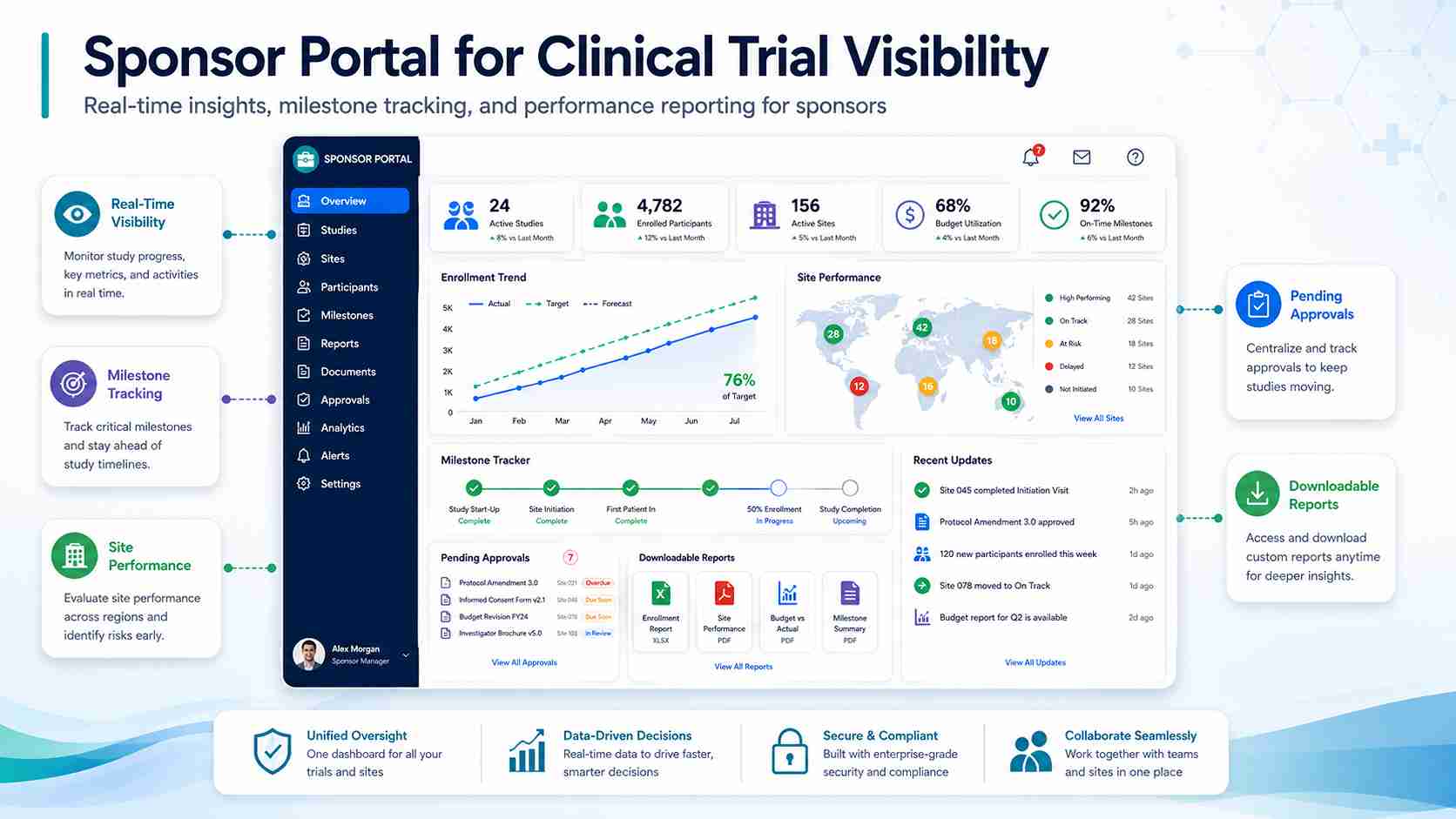
Sponsors need transparency. They want to know how the clinical trial is progressing, how many patients are enrolled, which sites are performing well, what milestones are completed, and whether there are any delays or risks.
Without a sponsor portal, clinical research companies usually share updates through manual reports, emails, presentations, or scheduled review meetings. This creates delays and increases dependency on internal teams.
A custom sponsor portal can provide sponsors with secure, real-time visibility into trial performance.
Key Features of a Sponsor Portal
A sponsor portal can include:
Trial progress dashboard
Patient enrollment status
Site performance reports
Milestone tracking
Document access
Visit completion status
Pending approvals
Budget utilization
Risk and delay indicators
Downloadable reports
Communication history
This improves trust between the clinical research company and the sponsor. Instead of asking for repeated updates, sponsors can log in and view the current status directly.
It also reduces the workload on internal teams because reports and dashboards can be generated automatically.
A sponsor portal makes the relationship more transparent, professional, and data-driven.
4. Investigator Portal: Improving Site and Investigator Coordination
Investigators play a critical role in clinical research. They are responsible for patient evaluation, protocol adherence, visit documentation, clinical observations, and trial-related updates.
However, many investigators and site teams still depend on emails, phone calls, paper forms, and manual communication with coordinators. This can create delays and confusion.
A custom investigator portal allows investigators and site teams to manage trial-related activities in a structured way.
Key Features of an Investigator Portal
An investigator portal can include:
Assigned study details
Patient visit schedule
Protocol documents
Site-specific tasks
Case updates
Document upload
Query response
Visit completion status
Alerts and reminders
Communication with coordinators
Training materials
Compliance checklist
This helps investigators access the right information at the right time.
For example, if a patient visit is due, the investigator can receive an automated reminder. If a document is pending, the portal can show it clearly. If a protocol update is released, the investigator can access the latest version from the portal instead of searching through email threads.
This reduces confusion, improves site productivity, and helps maintain better protocol compliance.
5. Patient Portal: Improving Patient Experience and Retention
Patients are at the centre of clinical research. Their experience directly affects recruitment, retention, visit completion, and overall trial success.
If patients do not receive proper communication, reminders, instructions, or support, they may miss visits, delay document submission, or drop out of the trial.
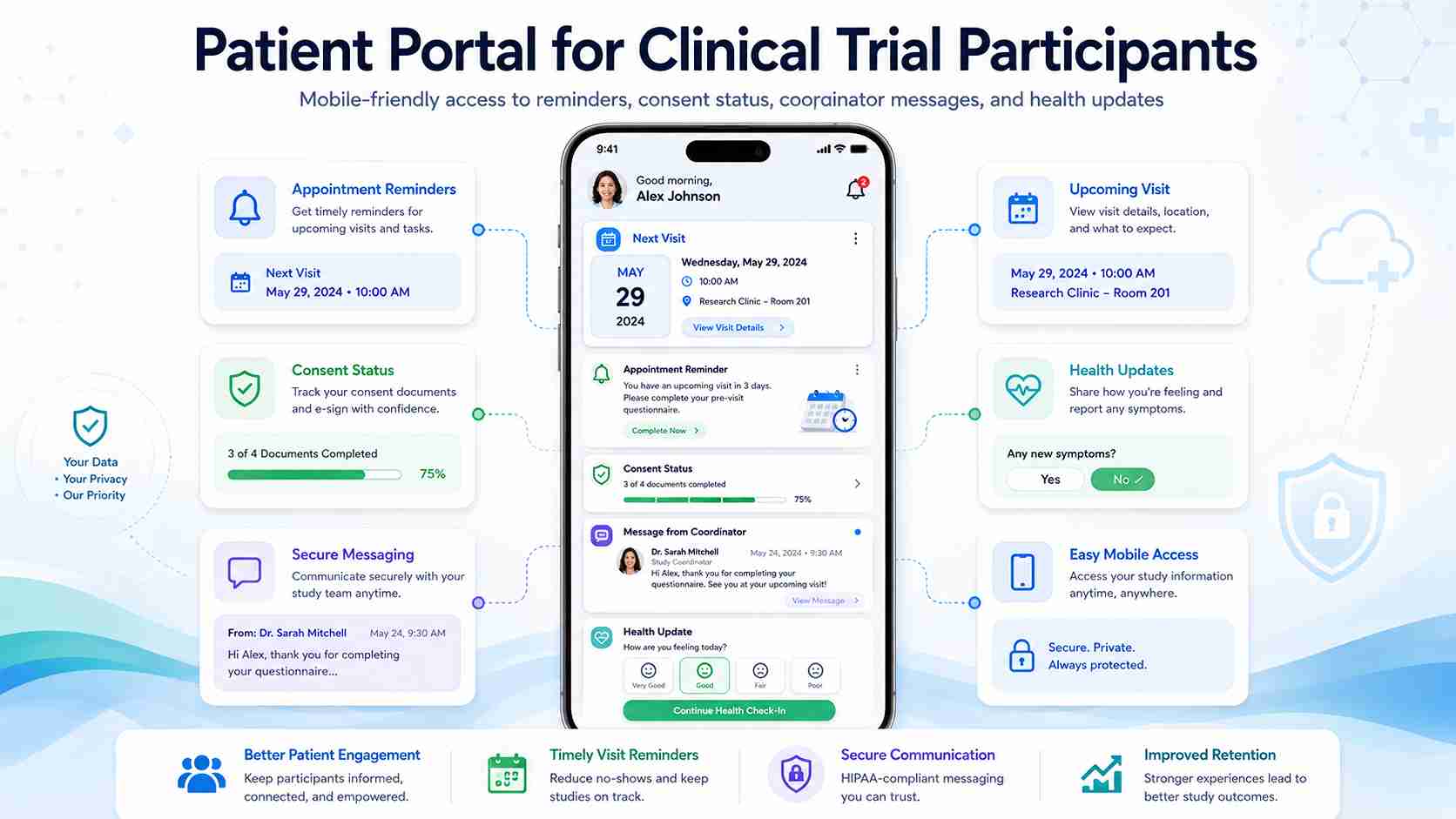
A custom patient portal can improve patient engagement by giving participants a simple and secure way to interact with the clinical research team.
Key Features of a Patient Portal
A patient portal can include:
Patient registration
Eligibility screening
Consent document access
Visit schedule
Appointment reminders
Health update forms
Secure communication
Document upload
Trial instructions
FAQ section
Notification alerts
Feedback forms
For example, a patient can log in to view their upcoming visit, receive reminders, complete basic forms, upload required documents, and contact the coordinator for support.
This improves patient satisfaction and reduces follow-up effort for the clinical research team.
A good patient portal should be simple, mobile-friendly, secure, and easy to use. Clinical research companies should not make patients struggle with complicated systems. The goal is to make participation smoother and more comfortable.
6. Coordinator Portal: Managing Daily Clinical Trial Execution
Clinical coordinators are the operational backbone of clinical research. They handle patient follow-ups, site coordination, visit schedules, document collection, investigator communication, sponsor updates, and internal reporting.
Their work involves constant tracking and follow-up.
Without a proper system, coordinators may depend on spreadsheets, WhatsApp messages, emails, phone calls, and handwritten notes. This increases the chance of missed tasks and delayed updates.
A custom coordinator portal gives coordinators a centralized workspace to manage daily clinical trial execution.
Key Features of a Coordinator Portal
A coordinator portal can include:
Daily task dashboard
Patient follow-up tracker
Visit scheduling calendar
Site coordination panel
Document pending list
Automated reminders
Investigator communication
Sponsor update requests
Patient status updates
Escalation alerts
Trial-wise task management
Internal notes and activity history
This helps coordinators prioritize work and avoid manual confusion.
For example, the system can show which patients need follow-up today, which documents are pending, which site has delayed updates, and which sponsor report is due. Instead of checking multiple files and messages, coordinators can manage everything from one dashboard.
This increases productivity and reduces operational pressure.
7. Internal Operations Portal: Centralizing Business Control
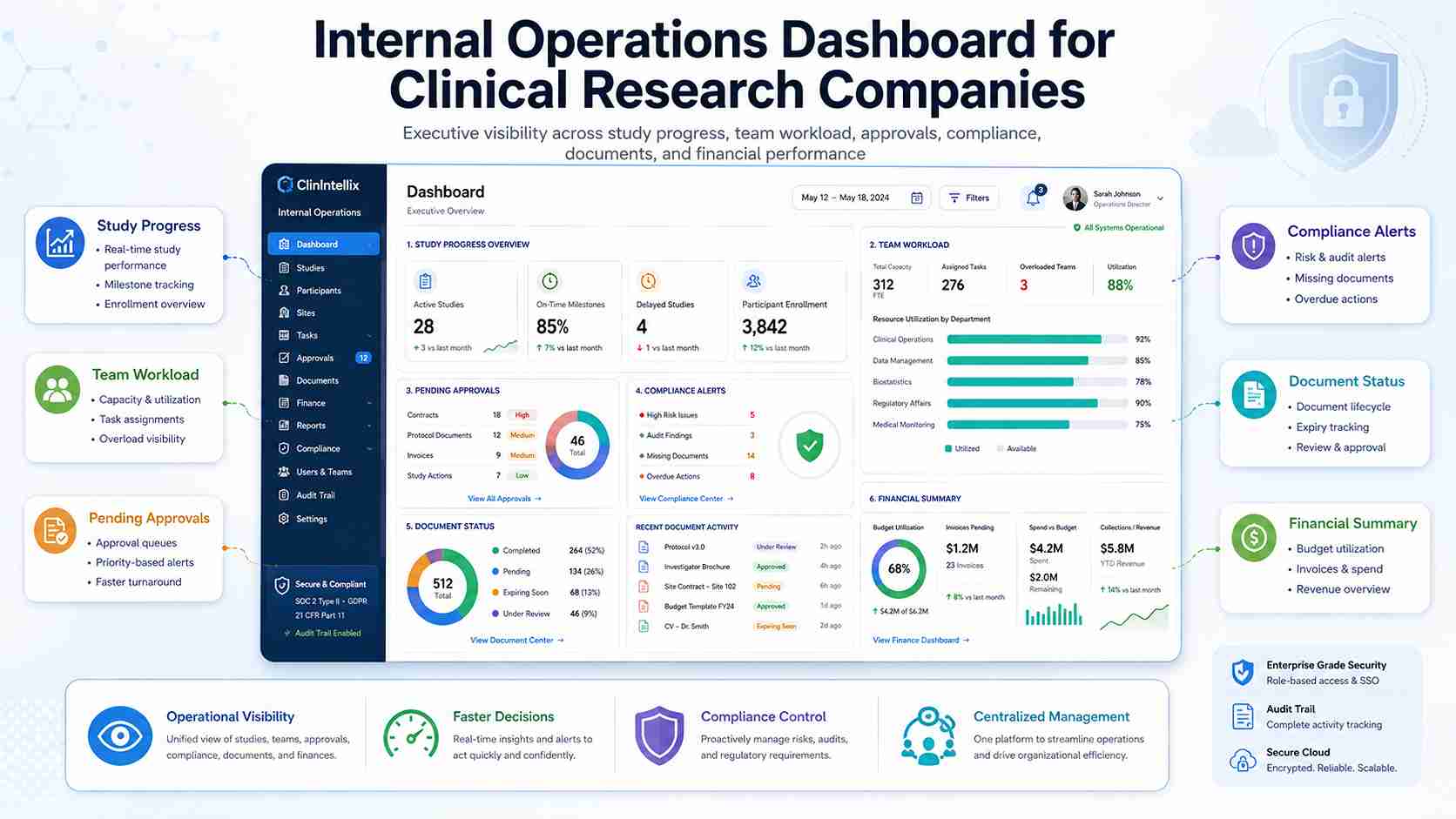 Clinical research companies also need strong internal operations management. Apart from trial execution, they must manage employees, finance, vendors, documents, approvals, compliance, client communication, and performance reporting.
An internal operations portal helps management teams run the business more efficiently.
Key Features of an Internal Operations Portal
An internal operations portal can include:
Employee role management
Department-wise dashboards
Study-wise progress tracking
Task and approval workflows
Finance and invoice tracking
Vendor management
HR and resource allocation
Document management
Compliance monitoring
Internal audit logs
Management reports
Performance analytics
This gives leaders a complete view of operations.
For example, management can track which studies are on schedule, which teams are overloaded, which invoices are pending, which documents are missing, and which operational risks need attention.
A strong internal portal helps the company move from reactive management to proactive decision-making.
8. Custom Applications Improve Data Accuracy and Reporting
Clinical research depends heavily on accurate data. Even small errors in patient status, visit completion, document version, or site reporting can create operational and compliance issues.
Manual data entry and scattered systems often lead to:
Duplicate records
Missing information
Delayed updates
Inconsistent formats
Wrong document versions
Poor reporting accuracy
Lack of ownership
Limited audit visibility
Custom enterprise applications improve data quality by creating structured workflows and validation rules.
For example, the application can make important fields mandatory, restrict incorrect entries, validate dates, prevent duplicate patient records, and maintain activity history. It can also generate automatic reports for sponsors, management, and internal teams.
This makes reporting faster and more reliable.
Instead of spending hours preparing weekly reports manually, teams can generate real-time dashboards and export reports directly from the system.
9. Security and Compliance Become Easier to Manage
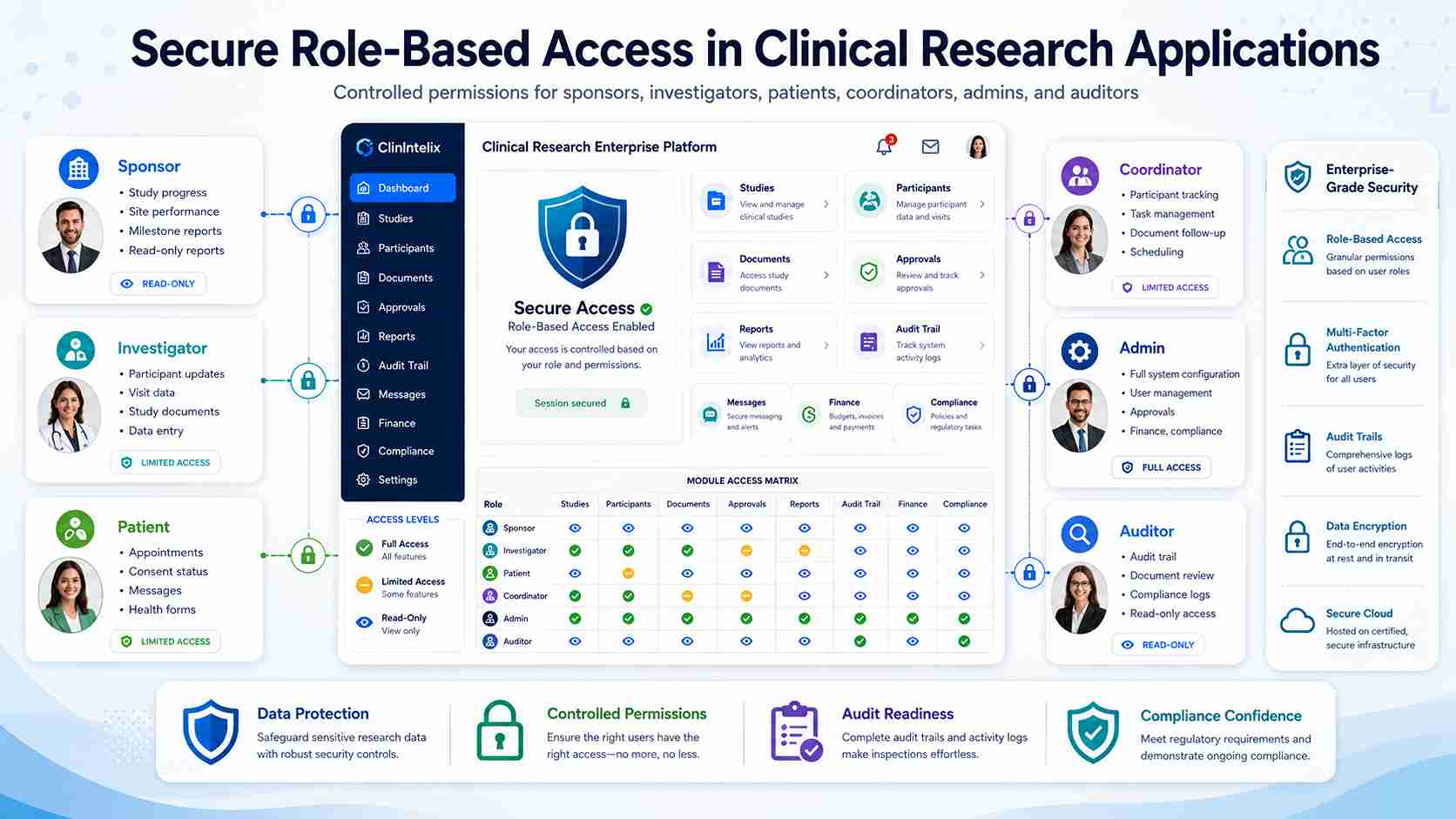 Clinical research companies handle security, which is not optional in this industry. A custom enterprise application can be built with security and compliance requirements from the beginning.
Important Security Features
A secure clinical research application should include:
Role-based access control
Secure login
Multi-factor authentication
Data encryption
Audit trails
User activity logs
Document access control
Backup and recovery
Secure cloud hosting
Permission-based downloads
Data retention policies
Version history
For example, sponsors should not have access to internal HR data. A patient should not access investigator notes. A coordinator should only access assigned study information. Management should have broader visibility based on business requirements.
Custom access control ensures that every user sees only the information they are allowed to see.
This protects sensitive data and reduces compliance risks.
10. Better Collaboration Across All Stakeholders
Clinical research succeeds when all stakeholders work together smoothly. Sponsors need visibility, investigators need clarity, patients need communication, coordinators need control, and internal teams need operational intelligence.
A custom business app brings all stakeholders into one secure platform
It reduces dependency on scattered communication channels and creates a single source of truth.
For example:
Sponsors can check progress
Investigators can update site activities
Patients can receive visit reminders
Coordinators can manage follow-ups
Management can review performance
Compliance teams can check audit logs
Finance teams can track invoices and payments
This level of collaboration is hard to achieve with generic software.
A custom application allows every stakeholder to work within the same system while still having separate access, permissions, and dashboards.
11. Scalability for Growing Clinical Research Companies
As clinical research companies grow, their operational complexity also grows. They may handle more studies, more patients, more sponsors, more sites, more investigators, and more documents.
Manual systems may work for a small team, but they cannot support long-term growth.
Custom enterprise applications are scalable. They can start with basic modules and expand over time.
For example, a company can begin with:
Study management
Patient tracking
Document management
Coordinator dashboard
Later, the same system can be expanded with:
Sponsor portal
Investigator portal
Patient mobile app
Finance module
AI-based reporting
CRM integration
Cloud data warehouse
Advanced analytics
Automation workflows
This allows clinical research companies to build technology step by step without replacing the entire system every time the business grows.
12. Business Benefits of Custom Enterprise Applications
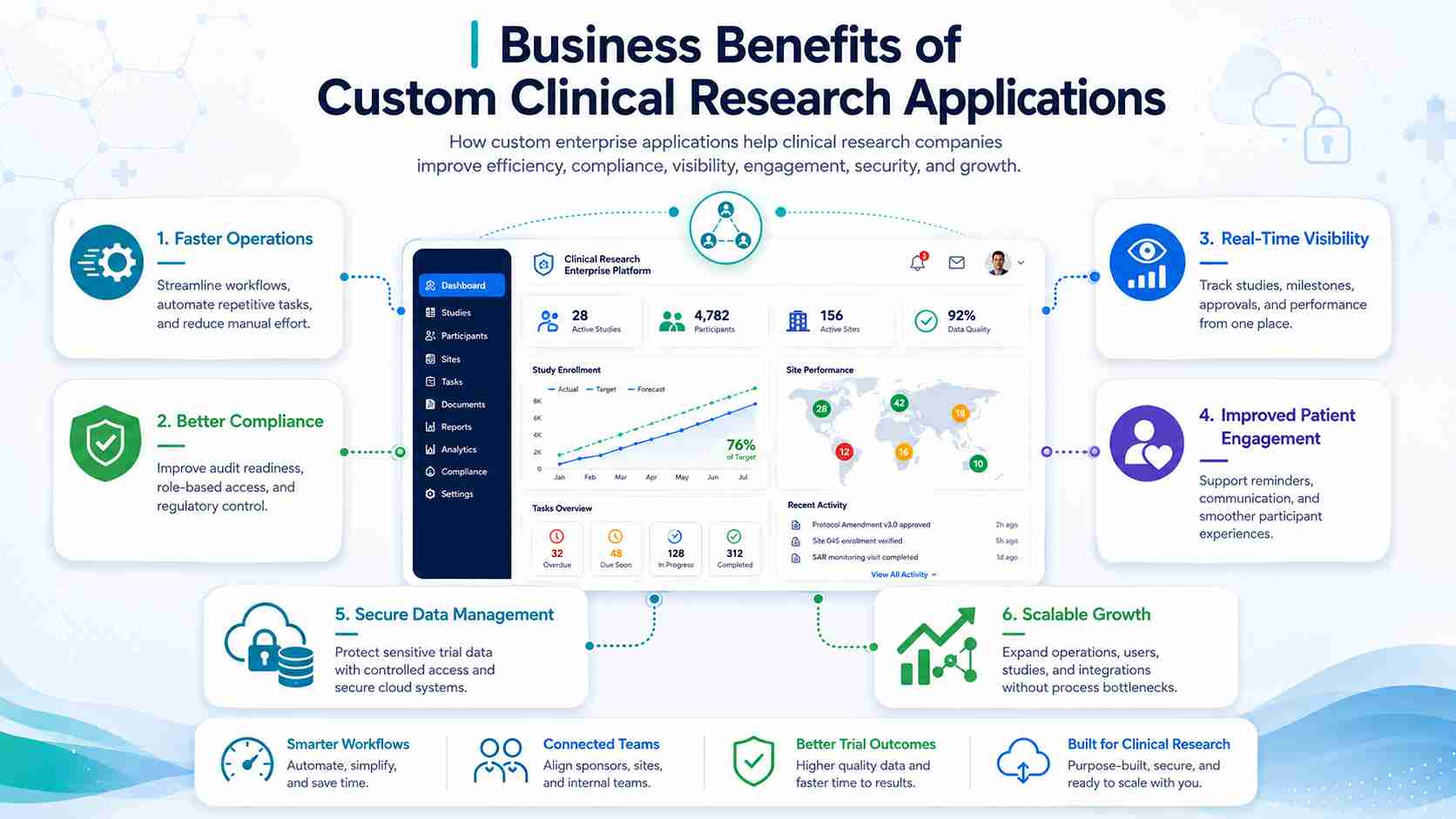 Custom enterprise applications provide both operational and business benefits.
Key Benefits
They help clinical research companies:
Reduce manual work
Improve trial visibility
Increase patient engagement
Improve sponsor communication
Strengthen investigator coordination
Reduce reporting delays
Improve document control
Enhance compliance readiness
Improve data accuracy
Centralize operations
Reduce dependency on spreadsheets
Improve management decision-making
Scale operations with confidence
In simple terms, a custom enterprise application helps clinical research companies work faster, smarter, and more securely.
It converts disconnected operations into a structured digital ecosystem.
13. How Revuteck Can Support Clinical Research Companies
Revuteck can help clinical research companies build custom enterprise applications that match their exact operational requirements.
Instead of offering a one-size-fits-all software product, Revuteck can design and develop digital platforms based on the company’s workflow, teams, stakeholders, reporting structure, and growth plans.
Revuteck Can Support With
Custom clinical research portals
Sponsor dashboards
Investigator portals
Patient portals
Coordinator dashboards
Internal operations platforms
Clinical trial workflow automation
Document management systems
CRM and patient recruitment systems
Data analytics dashboards
Cloud-based application development
Role-based access and security
API integrations
Reporting automation
Maintenance and support
Revuteck can also support with UI/UX design, web application development, mobile application development, cloud deployment, data engineering, analytics, automation, and ongoing technical support.
For clinical research companies, this means they can get a technology partner who understands enterprise application development and can create practical digital systems for real business operations.
Conclusion
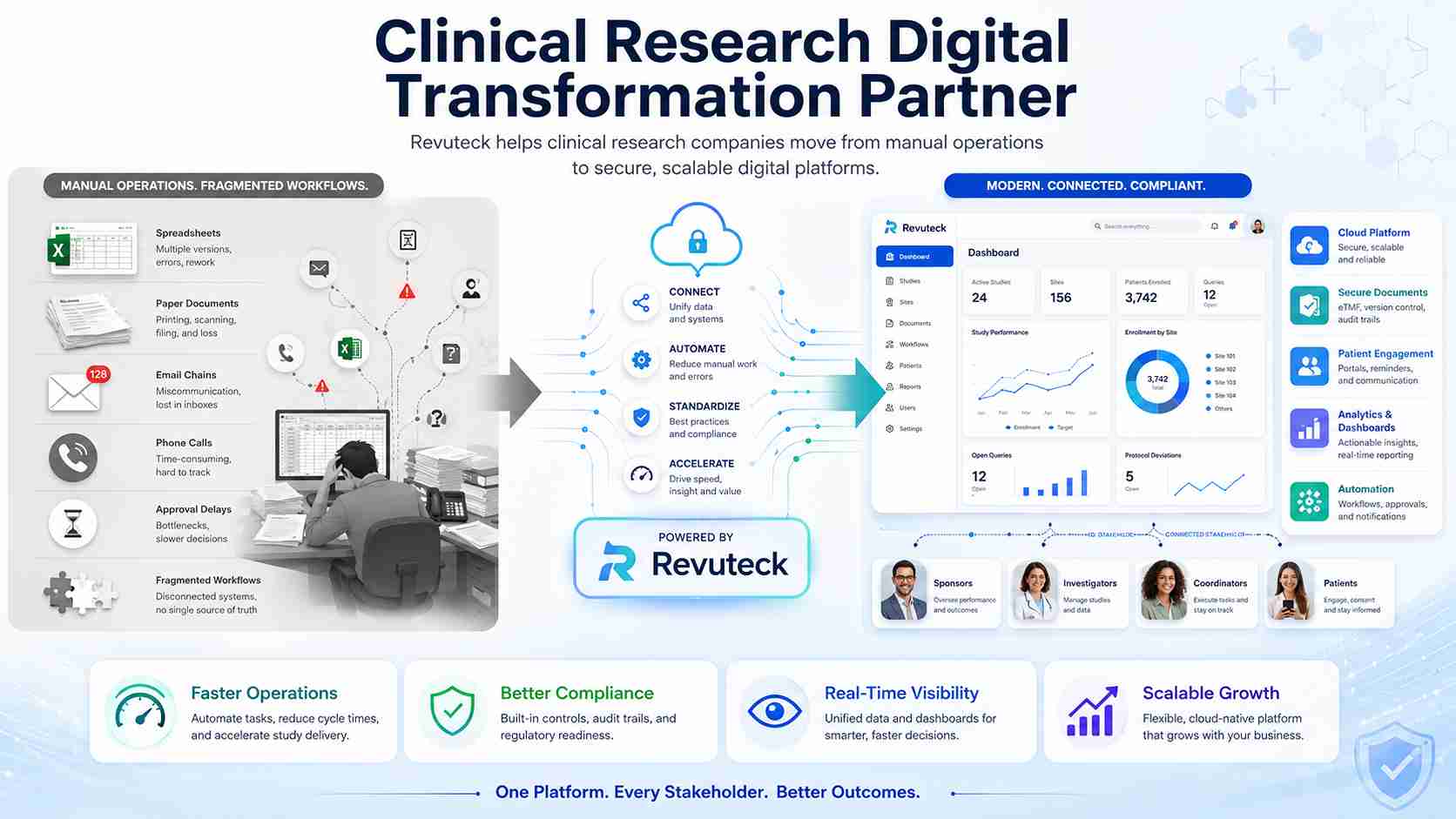
Clinical research companies need more than basic software tools. They need secure, scalable, and customized enterprise applications that can manage complex workflows across sponsors, investigators, patients, coordinators, and internal teams.
A well-designed custom enterprise application improves visibility, reduces manual work, strengthens compliance, improves patient engagement, and helps management make faster decisions.
As clinical research becomes more data-driven and digitally connected, companies that invest in custom enterprise applications will be better prepared to manage trials efficiently, serve sponsors professionally, support patients effectively, and scale their operations with confidence.
For clinical research organizations looking to modernize their operations, custom enterprise applications are no longer optional. They are becoming a foundation for better clinical trial execution and long-term business growth.