
Enterprise Digital Platform on Google Cloud: Scalable Enterprise Application Development with AI, Data Engineering, and Cloud Infrastructure
Enterprise Digital Platform on Google Cloud
Revuteck designed and delivered a complex, cloud-native digital platform on Google Cloud for an enterprise client that wanted to operate web, mobile, data, AI/ML, security, and production support capabilities under one scalable ecosystem.
The project was not limited to application development. It was designed as a complete digital business platform that could support customer-facing applications, vendor operations, internal admin teams, data analytics, AI-driven intelligence, secure cloud infrastructure, and real-time business monitoring.
The client’s objective was to build a future-ready platform that could start with a focused service offering and later expand into multiple business verticals, cities, user groups, and operational models without rebuilding the core system.
Business Requirement
The client needed a unified platform where customers could access services through a web application and mobile application, vendors or service partners could manage their assigned work, and internal teams could control operations through a secure admin portal.
The platform also required a strong backend system to manage bookings, users, payments, vendors, notifications, service workflows, customer support, and business rules. Along with the application layer, the client wanted a modern data platform to track customer behavior, revenue, bookings, vendor performance, operational efficiency, campaign performance, and service quality.
As the business was expected to scale, the architecture needed to support high availability, secure access, event-driven processing, data-driven decision-making, AI/ML use cases, and production-grade monitoring.
Problem Statement
Before implementing the solution, the client’s business model had multiple operational challenges. Customer interactions, vendor coordination, service tracking, payment updates, reporting, and support activities were either manually managed or spread across disconnected systems.
This created delays in operations, limited visibility for management, poor tracking of customer journeys, and difficulty in scaling the business to new locations or service categories.
The client needed a single enterprise-grade platform that could bring together application development, operational workflows, data engineering, AI/ML, security, monitoring, and cloud infrastructure into one integrated architecture.
Revuteck’s Solution Approach
Revuteck proposed a modular GCP-based architecture that separated the platform into clearly defined layers: user experience, API management, backend microservices, transactional databases, event processing, data engineering, AI/ML, security, DevOps, and monitoring.
The architecture was designed using Google Cloud services such as Cloud Load Balancing, Cloud Armor, API Gateway, Google Kubernetes Engine, Cloud Run, Cloud SQL, Firestore, Pub/Sub, Dataflow, BigQuery, Vertex AI, Cloud Monitoring, Cloud Logging, Secret Manager, Cloud KMS, and Security Command Center.
Instead of building a basic application, Revuteck designed the platform as a long-term digital foundation where new features, new service categories, new vendors, new dashboards, and AI models could be added without disturbing the core architecture.
Application Architecture
The application layer included three major user-facing systems: the customer web application, the mobile application, and the admin operations portal.
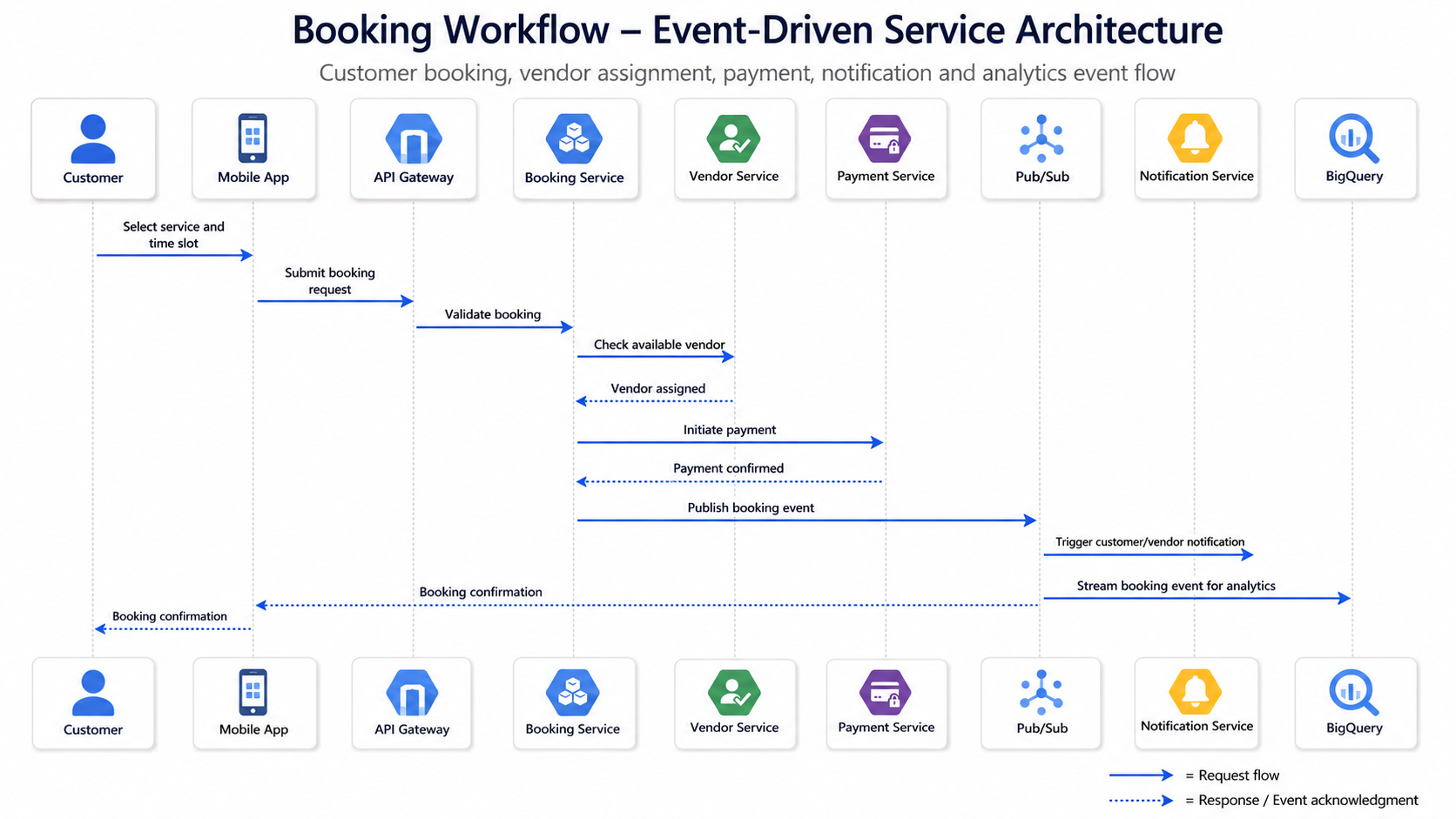
The customer web and mobile applications were designed to allow users to register, browse services, create bookings, make payments, track service status, receive notifications, raise support tickets, and view their transaction history.
The vendor application enabled service partners to receive assigned jobs, update job status, manage availability, view earnings, and communicate operational updates.
The admin portal was designed for internal business teams to manage users, vendors, bookings, payments, complaints, content, reports, and service configurations from a centralized interface.
The backend was designed using a microservices approach, where each major business capability was handled by an independent service. This included user management, booking management, vendor management, payment processing, notification handling, support ticketing, CMS, and workflow management.
Cloud Infrastructure Design
Revuteck designed the enterprise cloud infrastructure to support high availability, disaster recovery, scalability, and production-grade security.
All external traffic entered through Cloud DNS, Cloud CDN, HTTPS Load Balancer, and Cloud Armor. This ensured secure access, faster content delivery, DDoS protection, and web application firewall-level security.
The backend services were hosted on Google Kubernetes Engine for containerized microservices, while lightweight event-based or independent services were deployed on Cloud Run and Cloud Functions.
Cloud SQL was used for structured transactional data such as users, bookings, vendors, payments, and operational records. Firestore was used for real-time application data, while Cloud Storage was used for documents, images, invoices, receipts, service proofs, and other file-based assets.
Memorystore Redis was included for caching, session management, and improving response times for frequently accessed data.
Data Engineering Platform
A major part of the project was the data engineering architecture. Revuteck designed a modern data platform where operational data from applications, databases, and events could be collected, transformed, governed, and used for reporting.
Transactional data from Cloud SQL and Firestore was ingested into the data platform using Datastream, Pub/Sub, and Dataflow. Raw files and event data were stored in Cloud Storage as the landing zone.
Dataflow and Dataproc were used for data validation, cleansing, transformation, enrichment, and aggregation. Cloud Composer was used to orchestrate batch pipelines, recurring workflows, and dependency-based processing.
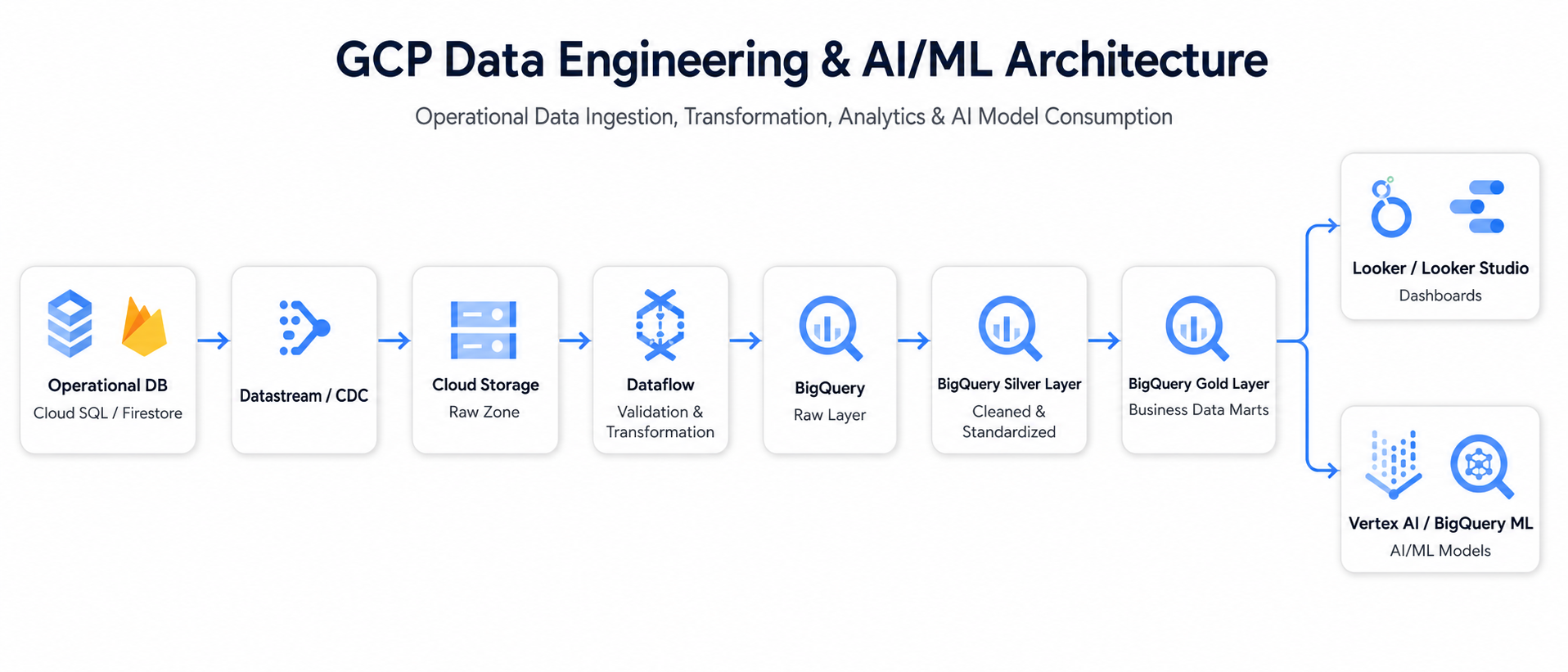 BigQuery was used as the central data warehouse. The data was organized into raw, curated, and business-ready layers. This helped the client maintain source-level history, cleaned business data, and final reporting datasets.
The final BigQuery gold layer powered dashboards for leadership, operations, finance, marketing, vendor management, and customer analytics.
AI/ML Capabilities
The platform was designed with AI/ML capabilities from the beginning. Revuteck included Vertex AI and BigQuery ML to support intelligent decision-making across the business.
AI/ML use cases included customer segmentation, service recommendations, churn prediction, demand forecasting, vendor performance scoring, fraud detection, and AI-assisted support automation.
For example, customer behavior and booking history could be used to recommend relevant services. Vendor response time, ratings, cancellations, and completion history could be used to rank the best vendor for a particular booking. Historical demand patterns could help the business predict which locations and time slots would have higher demand.
Vertex AI was used for model training, model registry, model deployment, and prediction endpoints. BigQuery ML was used for faster analytics-driven ML use cases, such as forecasting and segmentation, directly on warehouse data.
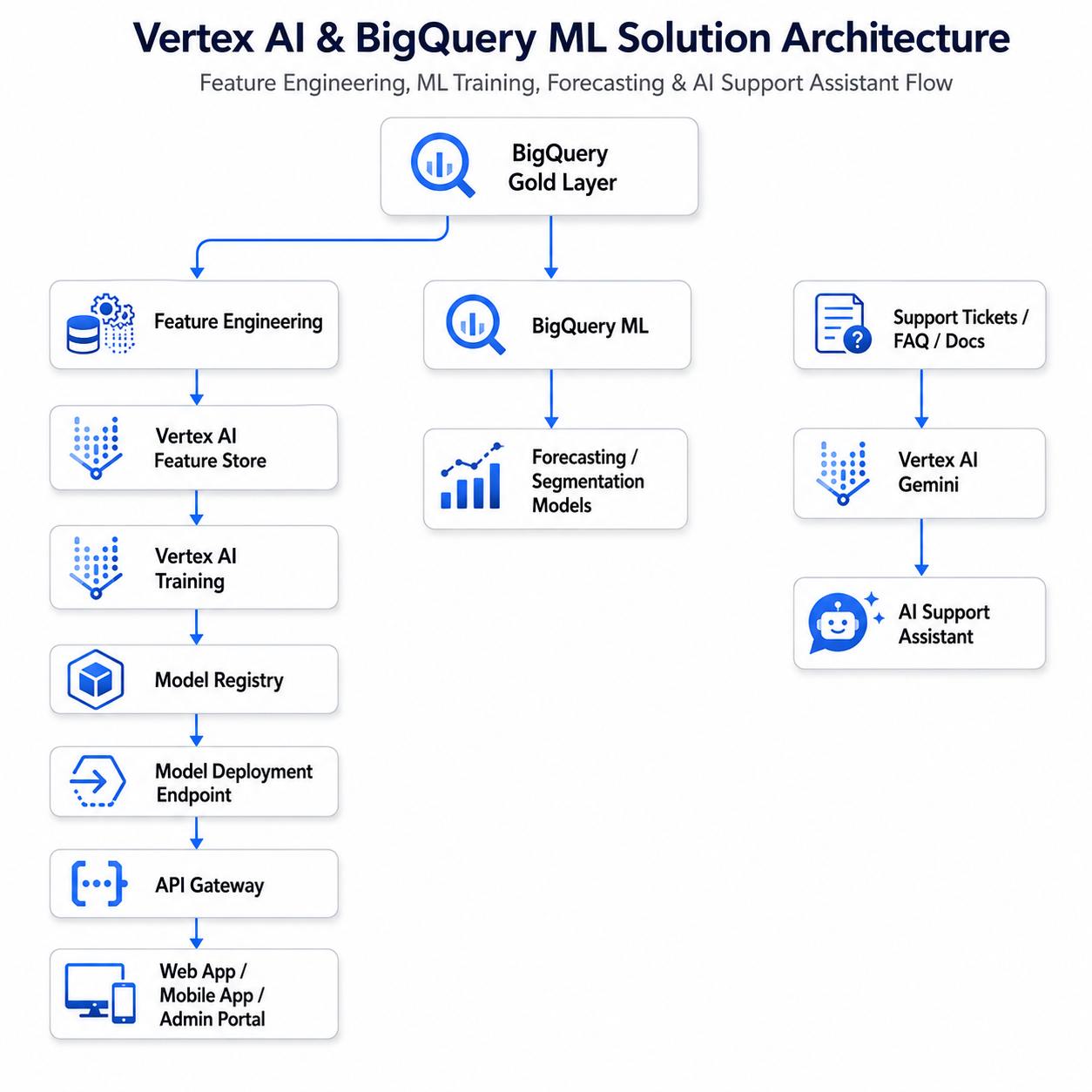 Vertex AI Gemini was proposed for AI-powered support assistance, where customer queries, FAQs, ticket history, and service documents could be used to generate intelligent support responses.
Security and Governance
Security was one of the most important parts of the architecture. Revuteck designed the system with identity control, network protection, data encryption, secrets management, audit tracking, and sensitive data protection.
Cloud IAM was used to control access based on roles and responsibilities. Identity Platform and Firebase Authentication were used for customer, vendor, and admin authentication. Identity-Aware Proxy was used to protect internal admin access.
Cloud Armor provided protection against malicious traffic, DDoS attacks, and common web threats. Secret Manager was used to store API keys, database passwords, payment gateway credentials, and third-party integration secrets.
Cloud KMS was used for encryption key management. Cloud DLP was included to detect and protect sensitive customer information such as phone numbers, email addresses, location data, and payment references.
Security Command Center and Cloud Audit Logs provided continuous visibility into security risks, access patterns, configuration issues, and audit events.
Monitoring and SRE
Revuteck designed the platform with production reliability in mind. The monitoring and SRE layer helped the client track application health, infrastructure performance, data pipeline status, and business-critical failures.
Cloud Monitoring was used to monitor service availability, CPU, memory, latency, API errors, database performance, and uptime checks. Cloud Logging was used to centralize logs from applications, APIs, containers, databases, and cloud services.
Cloud Trace helped identify latency bottlenecks in API calls. Error Reporting helped capture application exceptions. Cloud Profiler was included to analyze performance issues in backend services.
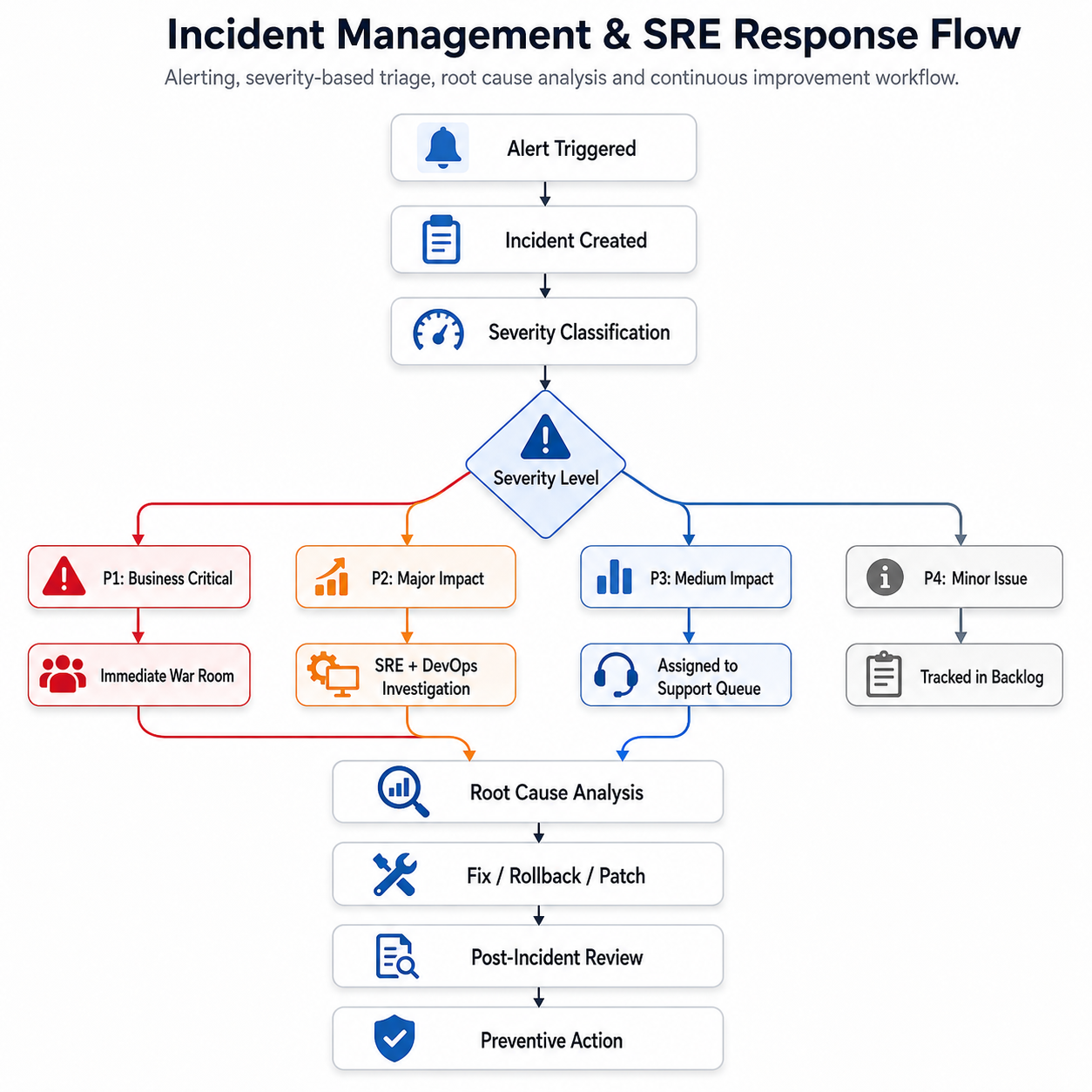
Alerting policies were configured for critical scenarios such as booking failures, payment failures, API downtime, high error rate, database performance degradation, failed data pipelines, and AI endpoint failures.
The platform followed an SRE-driven model with defined severity levels, incident response flow, root cause analysis, post-incident reviews, and preventive actions.
 DevOps and CI/CD
Revuteck implemented a structured DevOps approach to support faster and safer releases.
The source code was managed through GitHub. Cloud Build was used for automated builds, testing, security checks, and Docker image generation. Artifact Registry was used to store container images.
Cloud Deploy was used to manage releases across development, UAT, and production environments. Terraform was used for infrastructure provisioning to ensure consistency, repeatability, and controlled cloud resource management.
The deployment process included approval gates, environment separation, rollback support, and release tracking. This allowed the client to release new features without disrupting production users.
Business Dashboards and Reporting
The platform provided business-ready dashboards for different teams.
The leadership dashboard helped management track revenue, bookings, active users, customer growth, city-wise performance, and service-wise performance.
The operations dashboard helped internal teams track pending bookings, completed bookings, cancelled bookings, SLA breaches, vendor availability, complaints, and escalations.
The finance dashboard helped track successful payments, failed payments, refunds, revenue trends, outstanding amounts, and payment gateway performance.
The marketing dashboard helped measure lead sources, campaign conversions, customer acquisition trends, repeat customers, and offer performance.
The vendor dashboard helped analyze vendor ratings, job completion rate, response time, complaints, earnings, and performance ranking.
Key Technical Complexity
This project was technically challenging because it combined multiple complex systems into one architecture.
The platform had to support web and mobile applications, microservices, real-time booking workflows, event-driven processing, payment workflows, vendor operations, customer notifications, data pipelines, AI/ML models, security controls, monitoring, and production support.
The architecture also had to be flexible enough to support future expansion. New service categories, new regions, new vendors, new dashboards, and new AI models could be added without redesigning the entire system.
Final Outcome
Revuteck delivered a complete GCP architecture that enabled the client to move from a basic operational model to a scalable digital platform.
The final solution provided a strong foundation for application development, mobile experience, backend operations, secure cloud hosting, real-time event processing, business intelligence, AI/ML-driven decision-making, and production reliability.
The client gained a future-ready platform that could support current business needs while remaining scalable for future growth across multiple services, cities, customers, vendors, and business units.